How to Stay Consistent With Habits When Motivation Fades
The first week always feels easy. You wake up energized, the new routine feels exciting, and sticking with it barely takes effort. Then the second week arrives, the novelty wears thin, and suddenly the same habit that felt effortless now feels like something you have to talk yourself into. If this pattern sounds familiar, the problem was never your willpower. It was relying on motivation to carry a habit that was always going to need something steadier underneath it.
Why Does Motivation Always Seem to Disappear?
Motivation is genuinely an emotion, and emotions fluctuate based on sleep, stress, energy, and mood, none of which stay consistent day to day. Expecting motivation to reliably show up every single day is expecting an inherently unstable thing to behave predictably, which is precisely why it so often fails right when you need it most. The people who stay consistent long term are rarely more motivated than everyone else. They have simply stopped depending on motivation to be the thing doing the work.
What Actually Replaces Motivation?
Two things reliably do the job motivation cannot: identity and systems. Behavioral researchers who study habit formation have found that framing a behavior around identity, seeing yourself as someone who already does this thing, rather than someone chasing a distant goal, produces noticeably more durable consistency. There is a real difference between thinking “I want to exercise” and thinking “I am someone who exercises.” The second version makes skipping the habit feel like acting against who you already are, which carries far more weight than disappointing a goal you have not reached yet.
How Do You Actually Build an Identity Around a Habit?
Start small enough that showing up consistently is genuinely achievable, then let each completed instance reinforce the identity statement itself. Each time you follow through, however small the specific action, you are casting a vote for the version of yourself who does this consistently. Over time, those small, repeated votes accumulate into something that feels less like forced effort and more like simply who you are, which is exactly the shift that makes a habit survive long after the initial motivation that started it has completely faded.
Why Does Designing Your Environment Matter So Much?
Relying on willpower alone to overcome a poorly designed environment is an exhausting, losing battle. Reducing the friction standing between you and a good habit, laying out workout clothes the night before, keeping a book on your nightstand instead of your phone, makes the easy choice genuinely easier to make without requiring daily resolve. The reverse works just as well for habits you are trying to reduce. Adding even small friction, removing an app from your home screen, keeping a tempting snack out of easy reach, makes the less helpful choice require just enough extra effort to interrupt the automatic pull toward it. This same environment first thinking shows up directly in how to break a bad habit for good, where adjusting the surrounding environment consistently outperforms pure willpower.
What Should You Do on a Genuinely Low Energy Day?
This is where most consistency efforts quietly die, and it is also the easiest piece to fix. On a day when motivation is simply not there, scale the habit down to its smallest honest version rather than skipping it entirely. Two minutes of movement instead of a full workout. One page instead of a full chapter. A scaled down version keeps the identity and the streak genuinely intact, and showing up in a smaller form matters considerably more than people expect, since it protects the pattern itself rather than breaking it entirely for the day.
Why Is Missing Twice So Much More Dangerous Than Missing Once?
Missing a single day is simply human, and it rarely derails anything meaningful on its own. Missing twice in a row is where real risk begins, since a second consecutive miss starts quietly forming a new pattern, one built around not doing the habit, rather than doing it. Treat a single missed day as a non event, but treat a second one as a genuine signal to course correct immediately, even if that correction is simply doing the smallest possible version of the habit the very next day to break the emerging pattern before it sets.
How Can You Track Progress Without Depending on Feeling Motivated?
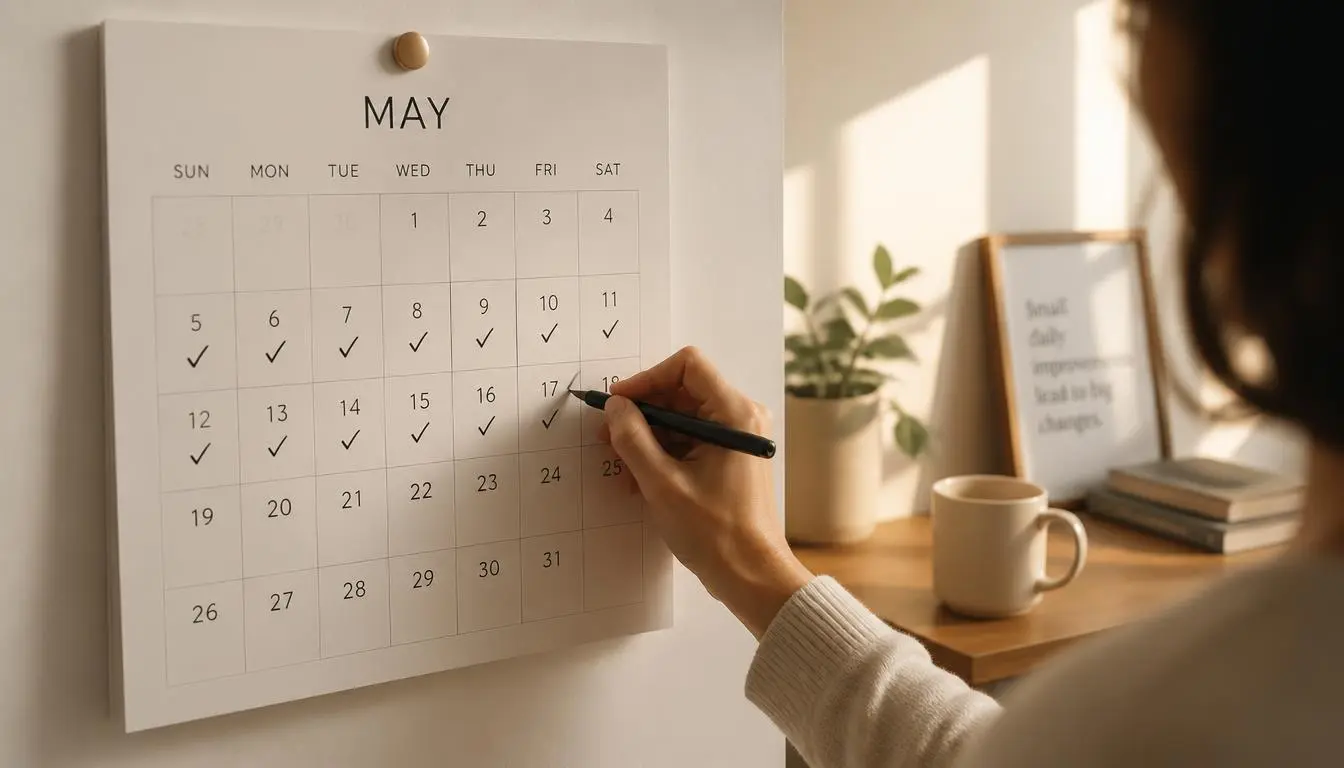
A simple visual record, even a basic calendar where you mark each day you follow through, gives you concrete evidence of consistency that does not depend on how you happen to feel in any given moment. Seeing a growing record reinforces the identity you are building far more convincingly than a vague internal sense of “I’ve been doing pretty well lately,” and it gives you something solid to return to on exactly the days when motivation feels completely absent.
Frequently Asked Questions
Why does the second week of a new habit feel so much harder than the first?
The initial enthusiasm and novelty of starting something new naturally fades after the first week, leaving the habit to run on whatever system or identity you have actually built underneath it. If that foundation is not yet in place, the drop in motivation becomes very noticeable right around this point.
Is it bad to miss a day of a habit I am trying to build?
No, missing one day is a completely normal part of building any lasting habit. What matters far more is what happens next. Missing a second consecutive day is where a genuinely risky new pattern can start to form.
What is the smallest version of a habit actually worth doing?
Whatever keeps the pattern technically intact without requiring real willpower on a low energy day, even something as small as two minutes of the activity. The goal on these days is protecting the identity and the streak, not matching your best effort.
Do identity-based habits really work better than goal-based ones?
Many behavioral researchers who study habit formation have found that framing a behavior around identity tends to produce more durable consistency than framing it purely around an external outcome, since skipping the habit then feels like acting against who you already are, not just falling short of a goal.
How long does it take before a habit stops requiring real effort?
This varies by person and by habit, but consistency tends to feel noticeably less forced once the identity and the environment supporting it are both genuinely in place, rather than after any fixed number of days.