
How to Understand Your Credit Score and Improve It
A three-digit number decides how much you pay in interest on nearly everything you borrow for the rest of your life, and most people have never actually seen what goes into calculating it. Understanding your credit score is not complicated once you know the five factors behind it, and once you know them, improving the number becomes a matter of a few specific, repeatable habits rather than a mystery.
What a Credit Score Actually Measures
A credit score is a three-digit number, typically ranging from 300 to 850, that summarizes how likely you are to repay borrowed money based on your credit history. The most widely used scoring model is the FICO score, and lenders generally consider a score between 670 and 739 to be good, with higher ranges considered very good or exceptional. A higher score typically means lower interest rates and better terms when you borrow, while a lower score means the opposite.
It is worth knowing that you do not have a single credit score. Different scoring models exist, and some lenders use industry-specific versions for auto loans or credit cards specifically. The two main models, FICO and VantageScore, use similar factors but weight them slightly differently, which is why your score can vary a little depending on where you check it.
The Five Factors, and How Much Each One Counts
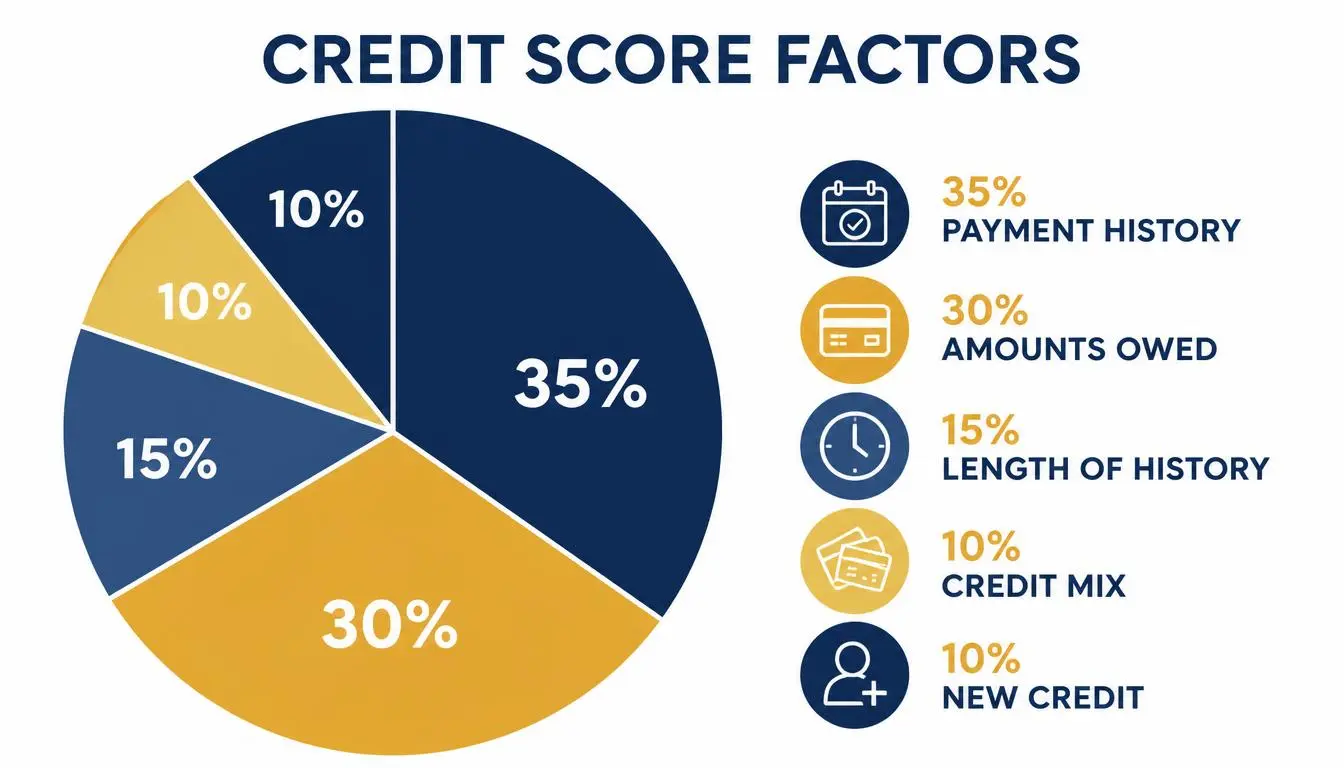
FICO does not publish its exact formula, but it is transparent about the five general categories that make up the score and roughly how much weight each one carries.
1. Payment History (35%)
This is the single biggest factor, and it reflects whether you have paid your bills on time across credit cards, loans, and other accounts. A consistent record of on-time payments is the strongest single signal of responsible borrowing, and missed or late payments drag the score down more than almost anything else on this list.
2. Amounts Owed, or Credit Utilization (30%)
This factor looks at how much of your available credit you are actually using, commonly called your credit utilization ratio. It is calculated both per account and across all your accounts combined. Lower utilization generally supports a higher score, and this factor carries almost as much weight as payment history itself.
3. Length of Credit History (15%)
This considers how long your accounts have been open, including the average age across all of them. A longer history generally helps, but it is not a strict requirement. Someone newer to credit can still reach a strong score with consistent on time payments and low utilization, even without decades of history behind them.
4. Credit Mix (10%)
This factor looks at whether you have experience managing different types of credit, such as revolving credit like credit cards alongside installment loans like a car payment or a mortgage. It carries a smaller weight than the first two factors, so it is not worth taking on debt you do not need purely to diversify this category.
5. New Credit (10%)
This reflects how many new accounts you have opened recently and how many hard inquiries appear on your report. Opening several new accounts in a short window can temporarily lower your score, since it can look to a lender like a sign of financial strain rather than routine activity.
The Habits That Actually Move the Number
Given how those five factors are weighted, a small number of habits do the vast majority of the work in building or repairing a credit score.
- Pay every bill on time, every time. Since payment history alone accounts for over a third of the score, consistency here matters more than any other single habit. Setting up automatic minimum payments, even if you plan to pay more, protects against an accidental missed due date derailing months of progress.
- Bring your utilization down. Aim to keep your total balances well under 30 percent of your available credit, and lower still if you can manage it. You can improve this ratio either by paying down existing balances or by requesting a higher credit limit, provided you do not use the extra room to spend more. Pairing this with a genuine debt payoff strategy tends to improve both your finances and your score at the same time.
- Leave old accounts open. Closing your oldest credit card might feel like tidying up, but it can shorten your average account age and reduce your total available credit at the same time, both of which can quietly hurt your score. Unless an old account carries a fee you genuinely cannot justify, it is usually better left open and used occasionally.
- Space out new credit applications. Apply for new credit only when you actually need it, and avoid opening several accounts within a short window, since each application typically triggers a hard inquiry that can shave a few points off your score temporarily.
- Check your credit report for errors. Mistakes on a credit report, an account that is not yours, a payment marked late that was actually on time, are more common than most people expect, and correcting them can produce a real, sometimes immediate improvement once fixed.
Building a Financial Foundation That Supports a Strong Score
A healthy credit score rarely exists in isolation from the rest of your finances. Consistent on time payments are considerably easier to maintain when you are not living paycheck to paycheck, which is part of why a modest emergency fund indirectly supports your credit score too, by giving you a buffer so an unexpected expense does not turn into a missed payment.
Be Patient With the Timeline
Credit scores respond to sustained behavior over months, not a single good decision. A late payment can affect your score for a period of time even after you catch back up, while a strong payment history and low utilization sustained over several months tend to move the number in the right direction steadily rather than overnight. Treat score improvement as a gradual, ongoing habit rather than a one time fix, and the underlying financial health it reflects tends to improve right alongside it.
Frequently Asked Questions
What is considered a good credit score?
Under the FICO model, a score between 670 and 739 is generally considered good, with higher ranges considered very good or exceptional. Different lenders may set their own thresholds for specific products, so requirements can vary somewhat.
Why do I have different credit scores from different sources?
Multiple scoring models exist, and FICO and VantageScore weight the same underlying factors slightly differently. Some lenders also use industry specific versions built for auto loans or credit cards specifically, which can produce a different number from the general score you see elsewhere.
Is it better to have zero credit utilization or a small amount?
A very low utilization ratio is generally seen as slightly stronger than a flat zero, since some active, responsibly managed usage demonstrates that you can handle credit rather than simply avoiding it entirely.
Will closing an old, unused credit card hurt my score?
It often does, since closing an account can shorten your average credit age and reduce your total available credit, both of which can lower your score. Unless the card carries a fee you cannot justify, keeping it open with occasional use is usually the safer choice.
How long does it take to improve a credit score?
It varies by individual situation, but meaningful improvement generally takes several months of consistent on time payments and lower utilization rather than happening immediately. Larger negative marks, such as a missed payment, can take longer to fully fade from their impact on the score.