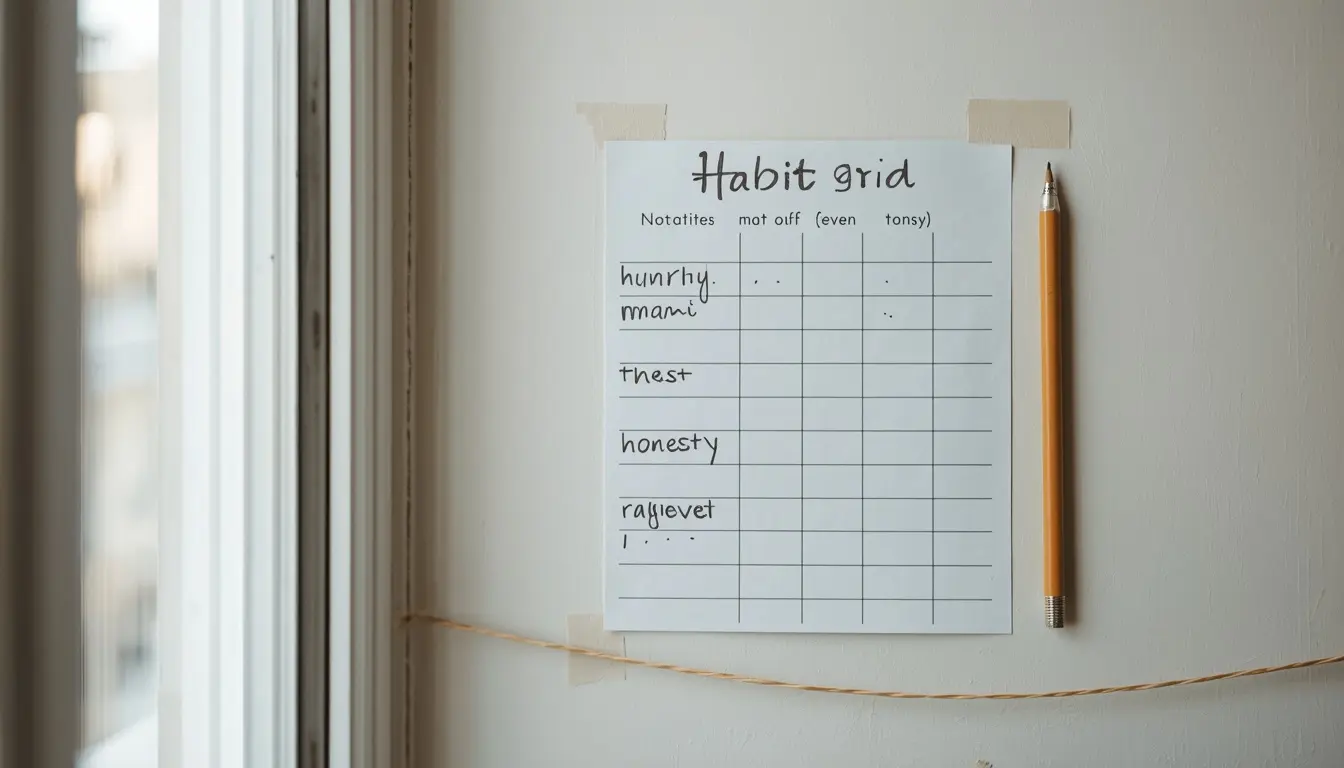
How to Build a Habit Tracker That Actually Works
Most of us have owned a habit tracker that lasted about three weeks. It started with a fresh page in January, a neat grid, a row of colored pens, and real enthusiasm. Then came a busy week, a few blank boxes, a small wave of guilt, and the whole thing quietly slipped behind a pile of papers. If that sounds familiar, it does not mean that you lack discipline. It usually means that the tracker was designed in a way that made it hard to keep. A habit tracker that works is small, clear, kind, and easy to see. This guide explains what research says about tracking, why most trackers fail, and how to build one that you will still be using in March.
Why Tracking Helps
Watching your own progress is one of the best supported tools in behavior change. A large meta-analysis by Benjamin Harkin and colleagues, published in Psychological Bulletin in 2016, pooled 138 randomized studies with nearly twenty thousand participants. It found that interventions that increased how often people monitored their progress also increased how often they reached their goals, with a moderate effect. It also found that monitoring worked better when the progress was physically recorded, for example written down, and when it was reported to someone else.
The message is encouraging, but it deserves some perspective. The effect is moderate, not magical, and a tracker is only a tool. Its job is to make progress visible, which matters more than it sounds. Without a record, it is easy to feel as though nothing is changing, even when you are doing better than you think.
How Long Habits Really Take
You may have heard that a habit takes twenty one days to form. That figure has no real scientific basis. The best known research on the question is a study by Phillippa Lally and colleagues at University College London, published in 2010, which followed ninety six people as they tried to make a new daily behavior automatic. The median time to reach a plateau of automaticity was sixty six days, but the range was enormous, from eighteen to two hundred and fifty four days. Simple behaviors, such as drinking a glass of water, tended to become habits faster than complex ones, such as an exercise routine. It is worth knowing that the longest figures were model estimates, since the study itself ran for twelve weeks.
A later review in 2024, which pooled twenty studies, found median times in a similar range, with large differences between individuals. The takeaway is that habits take weeks to months, and that the timeline depends on the person and the behavior. Plan for a long game, and do not treat sixty six days as another countdown. Lally’s study also found that missing a single opportunity did not materially affect the habit formation process, which is good news for everyone who has ever skipped a day.
Why Most Trackers Fail
Trackers tend to fall apart for a handful of predictable reasons.
- Too many habits. A grid with ten habits is exhausting to fill in and impossible to sustain.
- Goals that are too big. “Exercise for an hour” fails on the first busy day.
- All or nothing thinking. One missed day feels like failure, so the whole tracker is abandoned.
- No clear trigger. If the habit has no cue, it relies on memory, which is unreliable.
- A hidden tracker. A notebook in a drawer or an app you forget to open does not remind you of anything.
- Fiddly design. If updating it takes more than a few seconds, it will not get updated.
- Guilt. A tracker that makes you feel bad is a tracker that you will avoid.
Each of these has a simple fix, and the design rules below address them one by one.
Design Rules: Small, Clear, and Visible
Track Fewer Habits Than You Think
Start with one to three habits. It is far better to track two habits that you keep up than eight that you abandon. Choose habits that matter to you, since research on habit formation suggests that behaviors you choose for yourself tend to stick better than ones imposed from outside. If you want to add more later, do it only after the first ones feel automatic.
Define the Habit Clearly
Vague habits are hard to tick off. “Be healthier” cannot be tracked, but “walk for ten minutes after lunch” can. Write each habit as a specific action with a clear cue, such as “After I brush my teeth, I will read for ten minutes.” This kind of if-then plan gives the habit a trigger, and it is the idea behind habit stacking. Then decide on a minimum version, such as two minutes, so that even on your worst day you can still do something and tick the box.
Make the Tracker Visible
Put the tracker where you will see it every day, ideally next to the place where the habit happens. A grid on the fridge, a calendar by the bed, or a card on the desk works far better than something tucked away. Because the research found that physically recording progress helped, writing or marking a tick with your own hand is an advantage, not a nostalgic extra.
Track the Doing, Not the Perfection
Give yourself room to be human. Use two levels, a minimum and a bonus. A tick for the minimum counts as success, and a star for the full version is a pleasant extra. A partial day is still a day, and an honest blank is information, not a failure. Avoid language like “failed” or “broke the chain,” which turns a missed day into a verdict.
Add a Weekly Look Back
A tracker is more useful when you pause to read it. Once a week, spend five minutes looking at the pattern. Which days were easiest? What got in the way on the hard ones? Does the habit need a different time or a smaller version? This is a perfect companion to the practice in building a weekly planning routine, since both rely on short, regular reviews.
Choose Your Format
There is no best format, only the one that you will actually use. Here is how the common options compare.
| Format | Best for | Strengths | Weaknesses |
|---|---|---|---|
| Paper grid | People who like writing and want a visible reminder | Physical recording, no notifications, and easy to place where the habit happens | Can be lost, and has no reminders |
| Wall or desk calendar | One or two simple daily habits | A big, visible picture of the month at a glance | Limited space for more than a couple of habits |
| Notes app or spreadsheet | People who prefer digital and like customizing | Flexible, always with you, and easy to review | Easy to forget unless you set a reminder |
| Habit tracking app | People who want reminders and charts | Prompts, statistics, and sometimes a gentle nudge | Notifications can annoy, and streak features can add pressure |
If you are unsure, start on paper for a few weeks. It has the fewest moving parts, and it matches the research on physical recording.
Avoid the Streak Trap
Streaks, the count of consecutive days, can be motivating, since nobody likes to break a good run. But they can also backfire. When a streak is the whole point, a single missed day can feel like total failure, and some people respond by giving up completely. Remember that Lally’s research found that missing one day did not materially affect the formation of a habit. A kinder approach is the rule of never missing twice. If you skip a day, simply do the next one. You can also track a weekly count instead, for example “four out of seven days,” which rewards consistency without demanding perfection. If you tend to hold yourself to a flawless standard, how to let go of perfectionism offers gentle ways to loosen that grip.
What to Track: Some Examples
Choose habits that are small, specific, and meaningful to you. Here are a few ideas.
- Movement. A ten minute walk after lunch.
- Reading. Ten pages before bed.
- Sleep. Lights out by a set time, supported by the routine in building a nighttime routine for better sleep.
- Water. A glass with each meal.
- Money. A small saving transfer on payday, or a five minute check of your spending, as explored in building good financial habits that actually stick.
- Tidying. Five minutes to reset one area of your home.
When Tracking Stops Helping
A tracker is a support, not a lifelong requirement. If tracking starts to make you anxious, if you are ticking boxes just to keep a record, or if the habit has become automatic, it may be time to simplify. Pause the tracker, switch to a weekly review, or replace the habit with a new one. The aim is a life in which good routines happen naturally, and the tracker is only the scaffolding that helps you get there.
Set Up Your Tracker in Fifteen Minutes
You can build a working tracker in a single sitting. Follow these steps.
- Pick one to three habits. Choose things that matter to you, and write each as a specific action.
- Attach each to a cue. Complete the sentence “After I [existing routine], I will [habit].”
- Set a minimum version. Decide the smallest version that still counts, such as two minutes or one page.
- Choose a format. Paper, a calendar, a notes app, or an app. Pick the simplest one that you will see every day.
- Place it where you will see it. Put it next to the cue, such as on the fridge or beside your bed.
- Add a marker for the minimum and the bonus. A tick for the minimum, and a star for the full version.
- Schedule a weekly look back. Choose a day, put it in your calendar, and spend five minutes reading the pattern.
- Agree a missed day rule. Decide in advance that if you miss one day, you simply carry on the next, with no guilt attached.
Then begin tomorrow, with the smallest version of the smallest habit. The goal is not to fill a grid. It is to make your progress visible, and to be kind to yourself while it grows.