How to Write Meta Descriptions That Actually Get Clicks
Here is a common misunderstanding worth clearing up first: a meta description does not directly affect where a page ranks in Google. Many business owners skip writing one entirely for exactly this reason, assuming the effort is wasted. That assumption misses the actual value. A strong meta description does not move your ranking position, but it directly shapes whether someone sitting at that position actually clicks through to your site, and a higher click-through rate is one of the signals that can indirectly support better rankings over time.
What a Meta Description Is Actually Competing Against
In a results page full of similarly ranked links, your meta description is often the only piece of text a searcher reads before deciding where to click. Two listings covering the same topic can perform very differently purely based on which one promises a clearer, more specific answer to what that person actually typed into the search bar. Treat the description as a pitch for that one click, not a summary written for search engines.
How Long Should a Meta Description Actually Be?
Google does not enforce an official character limit. It truncates based on pixel width, roughly 920 pixels on desktop and considerably narrower on mobile, which means a description built from wide characters can get cut off sooner than one of the same character count built from narrower letters. In practical terms, aiming for somewhere around 150 to 160 characters on desktop, and tighter, closer to 120, for how it will likely display on mobile, remains the safest working target, since that is what most content management systems and SEO tools actually show you while writing.
What Separates a Description That Gets Clicked From One That Gets Skipped?
Lead With the Benefit, Not a Description of the Page
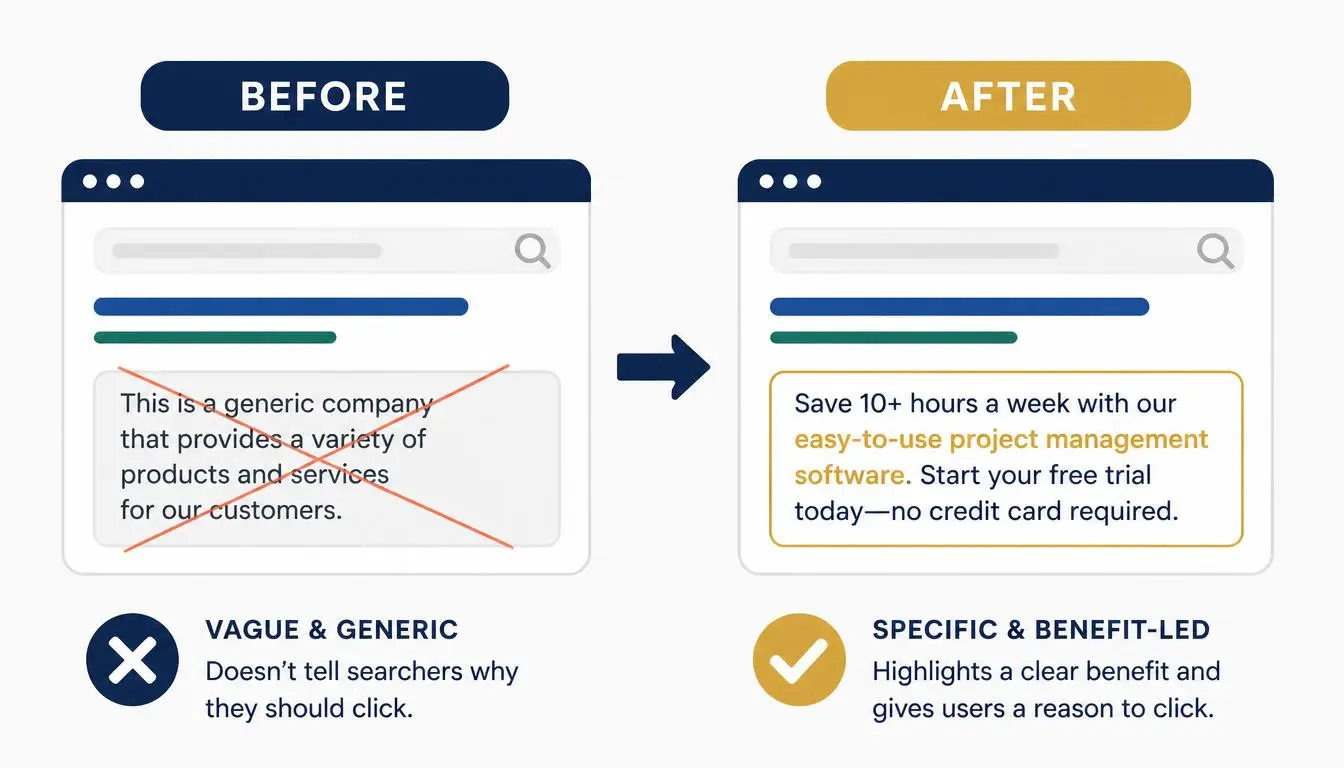
A weak meta description describes what the page covers. A strong one describes what the reader actually gets from clicking. Compare “This guide covers meta description best practices” against something closer to “Write meta descriptions that earn more clicks, with the exact character limits and a simple step by step process.” The second version gives a searcher a specific reason to click rather than a vague promise of relevant content somewhere on the page.
Match the Actual Intent Behind the Search
A searcher typing a specific question wants a specific, direct answer signaled back at them, while someone typing a broader, exploratory phrase is often looking for a comprehensive guide rather than one narrow fact. Mirroring that intent in your language, rather than writing one generic description style for every page regardless of what it is actually answering, measurably improves how relevant your listing feels before anyone has even clicked.
Include a Clear, Active Call to Action
Short, direct action phrases, learn, compare, get, see, give a searcher a concrete next step rather than leaving the description to trail off passively. Passive phrasing wastes valuable character space that could instead be doing real persuasive work.
Write One Complete, Natural Sentence
A meta description built from disconnected keyword fragments reads as obviously automated and does little to earn trust. Write it the way an actual person would describe the page out loud, working your primary keyword in naturally rather than stacking several keyword variations awkwardly together.
Where Most Businesses Go Wrong
The single most common mistake is reusing the same generic description, or none at all, across many different pages. Every indexable page deserves its own description written specifically for what that page actually answers. If writing unique descriptions for an entire site feels overwhelming, prioritize your highest traffic and highest value pages first, since these represent the most meaningful opportunity for improvement. A close second mistake is writing a description that overpromises or misrepresents what the page actually delivers. A misleading description might earn an initial click, but it also produces a visitor who leaves immediately, which does nothing good for your site’s longer term trust signals or conversion numbers.
Remember That Google Does Not Always Use What You Write
Google frequently rewrites a meta description automatically, generating its own summary instead, particularly when it judges a different snippet from the page content better matches a specific search query. This is not a reason to skip writing one. Your written description still gets shown a meaningful share of the time, and when Google does generate its own version, having strong, relevant content on the page itself still shapes what that automatic summary ends up saying.
The Bottom Line
A meta description will never move your ranking position on its own, but treating it as an afterthought leaves real, free clicks sitting on the table every single day your page appears in search results. Write a unique, benefit led sentence for every important page, keep it within a realistic length for how search engines actually display it, and match the language to what that specific searcher is actually hoping to find. None of this requires any technical skill, just the discipline to treat a small on page detail as genuinely worth getting right.