How to Organize a Home Office in a Small Space
By eight in the morning, the dining table has become a desk. By six in the evening, it is still a desk, with a laptop, a cold cup of tea, three sheets of paper, a tangle of charging cables, and no room left for dinner. If your home office lives in a corner, a hallway, a bedroom, or on a table that was meant for something else, you already know how quickly work spreads. The problem is rarely that you have too little space. It is that every item in a small space needs a clear job and a clear home. This guide shows you how to organize a small home office gently, one zone at a time, so that work has a place to live and your home gets itself back at the end of the day.
Start With What a Small Space Really Needs
When space is tight, the instinct is to buy more storage. A better first step is to ask what you actually use. Most small offices are crowded by things that do not need to be there: old paperwork, spare cables, supplies bought in bulk, and gadgets nobody has touched in a year. Organizing starts with fewer things, and then gives each remaining thing a place where it lives.
It also helps to think about what a small home office is really doing. It is not only a place to work. It is also a place that has to turn back into a living room, a bedroom, or a dining room when you stop. That is why the best small space systems do two things at once. They keep daily tools within easy reach, and they let the rest of the work disappear when the day is done.
Three Zones: Reach, Store, and Hide
Instead of trying to organize everything at once, divide your space into three zones based on how often you use things. Each zone has its own rule.
The Reach Zone: What You Use Every Day
This is the surface of your desk, and the space within an arm’s length of your chair. It should hold only the things you use daily, perhaps a laptop, a notebook, a pen, a lamp, and one small tray for papers you need to act on. Everything else belongs somewhere else. A nearly empty surface feels calmer and makes it easier to begin work, and it takes seconds to clear at the end of the day.
If you are also thinking about comfort and posture, the practical setup advice in setting up a budget friendly home office covers chairs, screens, and lighting, and it pairs well with the organization steps here.
The Store Zone: What You Use Weekly
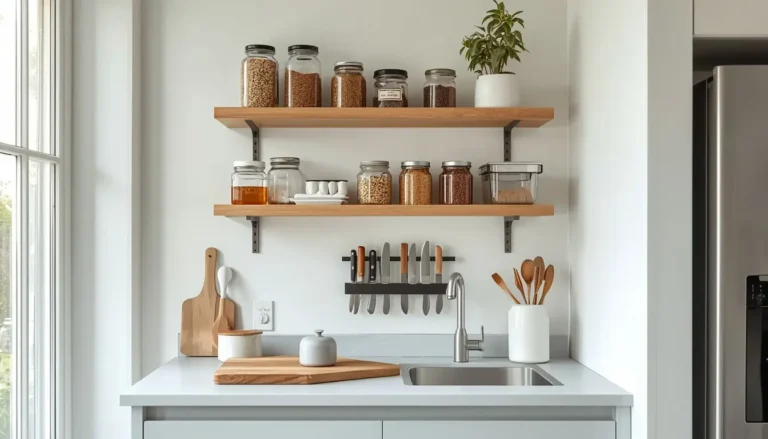
This zone is for the things you need regularly but not constantly, such as files, reference books, stationery, and a printer if you have one. The trick in a small space is to go vertical. Look at the wall above and beside your desk, which often offers the most useful storage you have. Floating shelves, a pegboard, a magnetic board, wall mounted file holders, and over the door organizers all move items off the desk and the floor. Even the back of a door can hold something useful. Give each item a clear home, and label boxes and bins so that you can find things in seconds. Keep the things you use most at eye level, and put backups higher up.
The Hide Zone: What You Rarely Use
Spare supplies, old files, seasonal items, and backup equipment belong out of sight. Use closed boxes on a high shelf, a storage ottoman, a bin under the bed, or a closet shelf. Closed storage also calms the visual noise of a room, which matters in a small space where everything is on show. If your office shares a room with your daily life, a cabinet, a basket with a lid, or a screen that closes over your desk can hide the work cues when you finish, so that your brain can switch off too.
Storage Ideas by Type of Space
The right solution depends on where your office actually lives. Here are some common situations and what tends to work.
| Where your office lives | The main challenge | What tends to work |
|---|---|---|
| A corner of a bedroom | Work clutter in a place meant for rest | A compact desk, closed storage, and a cover or screen to hide work at night |
| The dining table | Everything must be packed away daily | One box or tray that holds the whole setup, and a daily reset routine |
| A hallway or landing | Very little depth | A narrow wall mounted desk with shelves above it |
| A closet | Limited light and surface | Adjustable shelves, a small lamp, and a fold down desk or board |
| A shared living room | Work visible during relaxation time | A sideboard or hutch that hides equipment, and a tidy routine at the end of the day |
If you are measuring for anything new, measure the space carefully first, and consider the look of your whole room. The ideas in creating a capsule home decor style can help keep an office corner feeling like part of your home instead of an add on.
Tame the Paper
Paper is the quietest source of clutter, because it arrives every day and rarely leaves. A simple system stops it from piling up. Try the one touch rule: whenever you pick up a piece of paper, decide on the spot what to do with it, rather than putting it down to deal with later. Every paper then goes one of three places. Toss or shred it, file it, or place it in a tray if it needs action.
- An action tray for the few papers that need a response or a payment
- A small set of labeled folders for anything you must keep
- A shredder or a shred bag for papers with personal information
Scan what you can and keep digital copies, then match your digital folders to your physical ones, so the same names work in both places. If decluttering feels like too much at once, the gentle approach in decluttering your home without feeling overwhelmed shows how to start with one small area.
Tame the Cables
Tangled cables are both visual clutter and a trip hazard. A few small tools make a big difference: cable clips to hold wires along the edge of the desk, sleeves to bundle several cables together, and Velcro ties to keep loose ends neat. A power strip fixed under the desk keeps plugs off the floor. Label each cable end so that you can tell what is what, and remove cables you no longer use. Wireless accessories can also reduce the number of wires on your desk, though they bring their own chargers, so do not add more than you need.
Let Furniture Do Two Jobs
In a small space, furniture that works hard is worth its price. A fold down wall desk disappears when you are done. A console table can serve as a desk by day and a hallway table by night. A slim rolling cart holds supplies and tucks away under or beside a desk. A storage ottoman gives you both a seat and a hidden place for files. Before you buy any of these, measure the space, and think about how the furniture will look when it is closed as well as when it is open.
Keep Work From Taking Over Your Home
Organization in a small home office is partly about boundaries. When your workspace is also your living space, work can quietly follow you around. Decide on clear working hours, and end the day with a small ritual that marks the transition, such as closing your laptop, putting it in a drawer or a basket, and covering or clearing the desk. Seeing the space return to its home purpose helps your mind let go of work. If you want a gentle structure for planning your week, building a weekly planning routine pairs nicely with a tidy workspace.
A Five Minute End of Day Reset
A tidy office is built from tiny habits, not big weekend projects. The most useful one is a five minute reset at the end of each workday. It is short enough to do when you are tired, and it makes the next morning much easier.
- Clear the desk surface. Return pens, notebooks, and anything else to their homes.
- Empty the action tray. Deal with anything urgent, and move the rest to a list for tomorrow.
- Plug in your devices. Put your laptop, phone, and headphones on charge so that they are ready.
- Write tomorrow’s first task. Put it on a sticky note or the top of a list.
- Put the work away. Close the laptop, and hide it or cover the desk if the space is shared.
- Turn off the lamp. Let the room belong to your evening again.
Once a week, give the space ten extra minutes to file papers and put away supplies, and every few months, review your drawers, shelves, and cables, and let go of anything you no longer use.