How to Build Better Habits Using Habit Stacking
Every morning, there is a stretch of about ninety seconds when you stand beside the kettle and wait. You probably scroll your phone, or stare at the tiles, or think about nothing much. Nobody plans that pause. It simply happens, day after day, without any effort on your part. Now imagine using it, just once, to do one small thing you have been meaning to start. That is the whole idea behind habit stacking. You do not have to find new time or summon new willpower. You borrow a moment that is already yours.
The Moments You Already Have
Most of us try to build habits by squeezing something new into a day that already feels full. We set a reminder, promise ourselves we will remember, and then wonder why it slips away by Thursday. The trouble is not that you are lazy. It is that a new habit has nothing to hold on to. It floats free, waiting for you to remember it.
Your day, on the other hand, is full of things that happen without any thought at all. You make coffee, brush your teeth, sit down at your desk, shut the laptop, and put the kettle on. Each of those is a small, dependable moment. Habit stacking asks you to look at them kindly, and to see them as places where something gentle could be added.
The One Sentence Recipe
The method comes from behavior scientist BJ Fogg at Stanford, who calls the existing habit an anchor, and it was later popularized under the name habit stacking by author James Clear. It fits into a single sentence.
After I [anchor], I will [new tiny habit].
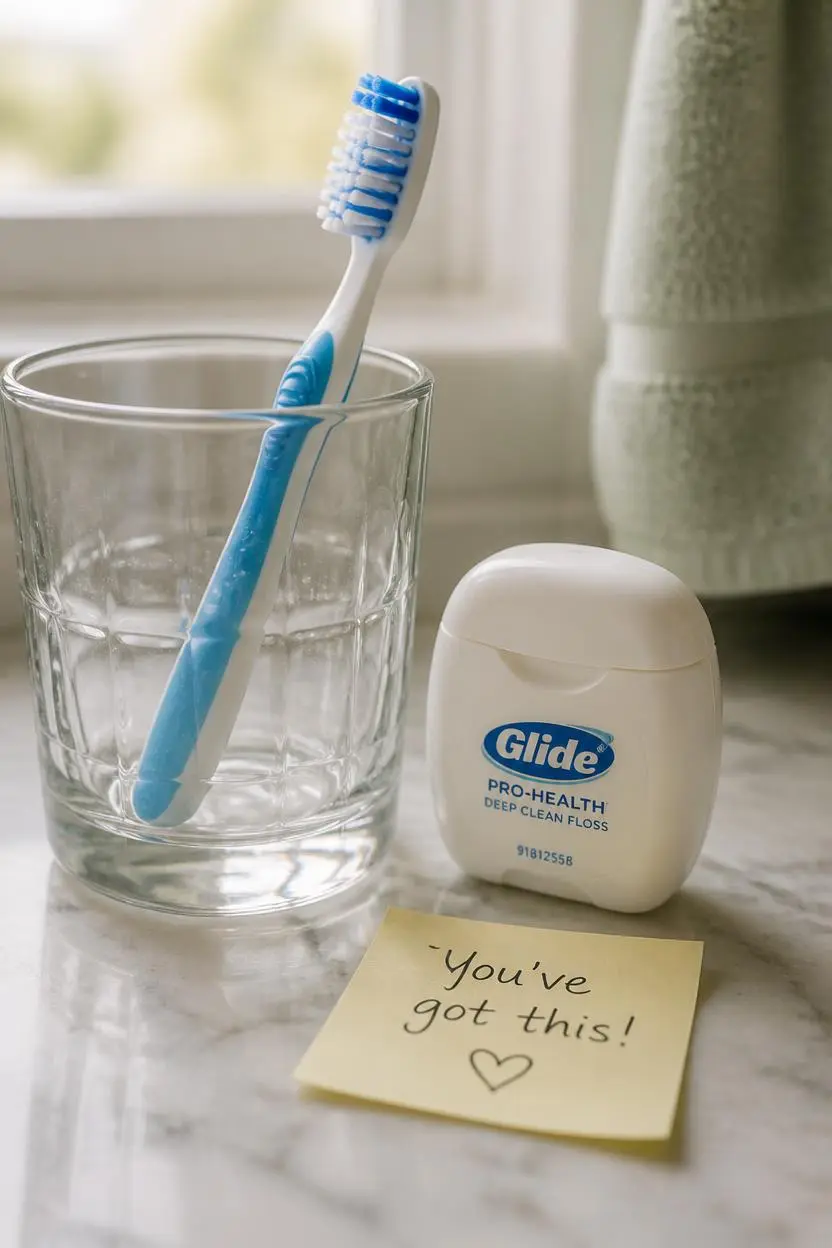
That is all. “After I pour my morning coffee, I will write one line in my notebook.” “After I brush my teeth, I will floss one tooth.” “After I close my laptop for the day, I will change into comfortable clothes and step outside for five minutes.” The anchor does the remembering. The new habit does not have to be impressive. It only has to be small enough that you will actually do it.
Why This Works Without Willpower
Psychologists who work with habit change often point out that we stick to habits more reliably when they are cue driven. Something in your day tells you it is time, so you do not have to decide. With habit stacking, the cue is an action you already perform every day, which means the cue is dependable and free.
The same experts stress that the most important ingredient in any new habit is consistent repetition. A cue that shows up every day supports frequent repetition, and repetition is what slowly moves a behavior from effortful to automatic. There is also a useful side benefit. Anchors based on what you do, such as finishing a meal, tend to survive a changing schedule better than anchors based on a clock. If your morning runs late, you still pour the coffee, and your new habit comes along with it.
Choosing an Anchor That Will Not Let You Down
A good anchor is the difference between a stack that holds and one that collapses. Look for these qualities.
- It happens every day. If you want to do something three times a day, choose an anchor that also happens three times a day.
- It is specific. “After breakfast” is better than “in the morning,” and “after I put my plate in the dishwasher” is better still.
- It is in the right place. Choose an anchor in the same room where the new habit will happen, and keep anything you need right there beside it.
- It matches the energy. A calm anchor suits a calm habit. Do not stack a quiet stretch onto the moment you rush out the door.
It helps to write down the things you already do automatically, in order, from the moment you wake up. Seeing the list on paper often reveals anchors you never noticed.
Start Smaller Than Feels Reasonable
Most people begin far too big, and then quietly give up. A habit that takes under two minutes is not a trick or a cop out. It is the point. A very small version removes the need for motivation, which rises and falls like weather, and it lets you succeed on the days when you feel least like trying.
So the book you want to read daily becomes one page. The workout becomes two minutes of stretching. The journaling becomes a single sentence. Once the tiny version feels automatic, you can let it grow, and if you ever feel resistance, you are allowed to shrink it back down again. There is no prize for suffering through a larger version.
Recipes You Can Borrow
Here are a few starting points. Change the words until they sound like your own life.
In the Morning
After I turn on the kettle, I will drink a full glass of water. After I make my bed, I will open the curtains and take three slow breaths. After I sit down at my desk, I will write down the one thing that matters most today. If mornings are a struggle, a morning routine that sticks pairs naturally with this approach.
During the Day
After I finish lunch, I will walk around the block once. After I send my last email of the afternoon, I will tidy my desk for sixty seconds. After I hang up a phone call, I will stand up and stretch my shoulders.
In the Evening
After I put my plate in the dishwasher, I will lay out tomorrow’s clothes. After I brush my teeth, I will put my phone on the charger across the room. After I get into bed, I will read one page of a book, and nothing more.
Let Yourself Celebrate
Fogg is emphatic about one more ingredient, and it is the one people skip. Right after you finish the new habit, feel good about it, even for a second. A small smile, a quiet “yes,” a little fist pump. It may feel silly at first. But the feeling you attach to the habit is part of what teaches your brain to want it again, and a habit that feels like a small win survives much longer than one that feels like a chore.
When a Stack Wobbles
Sometimes a stack does not hold, and that is useful information, not failure. Check the usual culprits. The anchor may not happen reliably, so choose a steadier one. The habit may be too large, so shrink it. The recipe may be vague, so make it more specific. Or you may be adding too many new habits at once, so choose one and let it settle first.
If you are using this method to replace something you would rather stop doing, the thinking in how to break a bad habit for good fits well alongside it, since a new response needs somewhere to go. And on days when everything feels harder, remember that systems carry you further than effort does, an idea explored in building self discipline without burnout.
Adding a Second Habit to the Chain
Once your first stack feels automatic, you can chain a second habit onto the first. “After I pour my coffee, I will write one line in my notebook. After I write that line, I will open the window.” The first new habit becomes the anchor for the next one. Keep the second habit just as small. You can also pair something you need to do with something you enjoy, so the pleasant thing follows the useful one.
How Long It Really Takes
You may have heard that habits take twenty one days. The honest answer is more varied. One widely cited study found that new behaviors took about two months to become automatic on average, with a very wide range between people and between habits. Simple habits took less time, and harder ones took far longer. So let go of the calendar. Judge your progress by whether the habit is becoming easier, not by how many days have passed.
A Gentle Place to Begin
You do not need to redesign your life this week. Pick one moment that already belongs to you, the kettle, the toothbrush, the first sit down at your desk. Write one sentence. Make the new habit so small it almost feels silly. Then let the moment do the remembering for you.
If it sticks, wonderful. If it does not, you have learned something about your day, and you can try a different anchor tomorrow. Either way, you are not starting from zero. You are starting from everything you already do, and that is a better place to begin than you might think.