How to Build Customer Trust for a New Online Store
Every first-time visitor to your store arrives with three silent questions. Is this business real? Is my money and my information safe here? And if something goes wrong, will they treat me fairly? A shopper may never say these questions out loud, and they will not read your mission statement to find the answers. They will scan your pages for a few seconds, and then they will either keep going or leave. For a new store with no reputation, no reviews, and no history, customer trust is not a nice extra. It is the real product you are selling, and everything else you sell depends on it. This guide shows you how to build trust from zero, using a four-rung ladder, a table of shopper worries, and a plan for your first thirty days.
Why Trust Is the Real Product for a New Store
Online shoppers are skeptical by default, and for good reason. They are being asked to hand over card details to a stranger, wait for goods they cannot touch, and hope the product matches the photos. Many have been burned before. Research on cart abandonment from the Baymard Institute, as reported by several e-commerce publications, has found that somewhere near one in five shoppers who abandon a purchase do so because they do not trust the site with their payment information. Even that single figure shows how many sales are lost without anyone ever complaining.
Large established brands borrow trust from their names. A new store has to build it from scratch, and it cannot rely on reviews at first, so it must make up for that by getting everything else right. That is the idea behind the ladder below.
The Trust Ladder: Four Rungs
Each rung answers one of the shopper’s questions. Climb them in order, because each one supports the next.
Rung One: Look Like a Real Business
Legitimacy comes first. A shopper wants evidence that real people stand behind the store.
- Visible contact details. Show an email address, a contact form, and a phone number or chat if you can. Hiding contact information signals that you do not want to be reached after a sale.
- A genuine About page. Say who you are, why you started the store, and where you are based. Real names and photos help.
- Business information. Where your country requires it, display your registered business name and address in the footer.
- Original photography. Photos taken of your actual products, from several angles, are far more convincing than manufacturer images that every other store also uses.
- A clean, consistent design. A site that loads quickly, works on a phone, and has no broken links or typos feels dependable. Sloppy details make shoppers wonder what else is sloppy.
Rung Two: Make Checkout Feel Safe
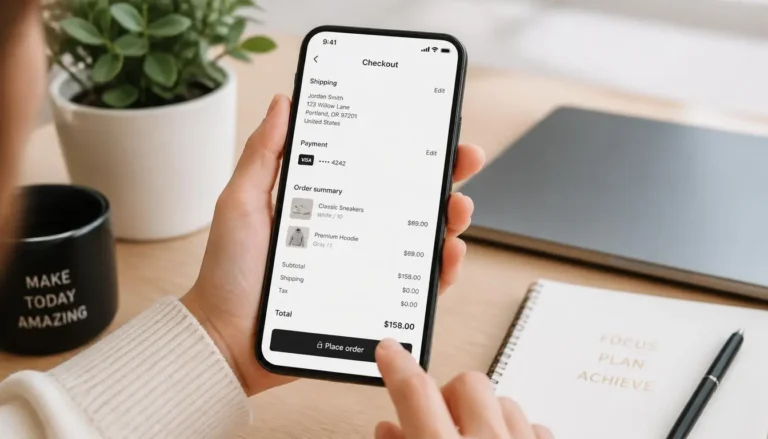
The riskiest moment in the whole journey is the second a shopper reaches for their card, so the checkout needs to reassure them. Make sure your site uses a secure connection, which shows as https in the address bar, though remember that this only proves the connection is encrypted and not that a store is honest. Offer payment methods that people recognize and trust, and show them near the payment fields. Avoid any surprise costs, since shipping and fees that appear at the last step are among the main reasons people abandon a purchase, a problem explored in reducing cart abandonment. Offer guest checkout so that nobody is forced to create an account. Publish a clear privacy policy, and be honest about how you use customer data.
One warning about badges. Only display security or trust seals you have genuinely earned. Shoppers are increasingly told to click on them and check, a habit taught in how to safely shop online without getting scammed, and a fake badge destroys credibility instantly.
Rung Three: Prove It With Honest Evidence
Reviews and testimonials are the most direct proof a store can offer, but a new store does not have them yet. That makes honesty even more important.
First, never fake reviews. Fabricated testimonials and inflated review counts are not only unethical, they are restricted by regulators in many countries, and savvy shoppers spot them. A page filled with nothing but five star raves often reads as fake, and a few honest, balanced reviews tend to be more believable than a spotless wall of praise. If your store has no reviews yet, hide an empty review section until you have a few real ones, since a blank box creates doubt.
Instead, earn your first reviews honestly. Email every early customer a few days after delivery, thank them, and ask for feedback. Make it easy, with a direct link and a short form. Invite photo reviews, which are harder to fake and more helpful to other shoppers. Ask permission before you share anyone’s words or image. And respond politely and openly to any critical review, because how you handle a complaint often builds more trust than the praise does.
While you wait for reviews, use other forms of proof. Detailed product information, clear specifications, honest sizing guidance, and a visible guarantee all help. The descriptions in writing product descriptions that actually convert explain how to make your product pages precise and truthful.
Rung Four: Keep Your Promises
The last rung is the one that turns a first time buyer into a returning customer. Trust is built by what happens after the sale, so deliver on everything you said.
- State realistic delivery times, and meet them. It is better to promise a little longer and deliver early.
- Send order confirmations and tracking details so customers always know where their order is.
- Answer questions quickly, before and after the sale. Fast replies are a signal of reliability in themselves.
- Make returns simple, and handle them without friction.
- Fix problems generously. A customer whose problem was solved well often becomes more loyal than one who never had a problem.
Keeping in touch afterward matters too, and a list of customers who chose to hear from you becomes an asset over time, as explained in building an email list from scratch.
What Shoppers Worry About, and What Answers It
| The worry | What builds trust | Where to show it |
|---|---|---|
| Is this store real? | Contact details, an About page, and business information | Header, footer, and About page |
| Will my card details be safe? | A secure connection and recognized payment methods | Checkout and payment fields |
| Will the product match the photos? | Original photos, clear specifications, and honest reviews | Product pages |
| What if I need to send it back? | A plain language return policy | Near the buy button and in the cart |
| When will it arrive? | Clear delivery times and costs upfront | Product page, cart, and order emails |
| Will anyone help me? | Fast, friendly, visible support | Contact page, chat, and order emails |
Make Returns and Shipping Crystal Clear
Many shoppers check the return policy before they buy, so hiding it in a dense legal page is a mistake. Write it in plain language, include a short summary near the buy button, and state the key facts: how long customers have, what condition items must be in, who pays for return shipping, and how long a refund takes. Do the same for delivery. Give realistic timeframes and costs on the product page, not just at checkout. A generous, clear policy costs you something when customers use it, but it usually earns more in confidence than it costs in returns.

Trust Killers to Avoid
- Fake urgency. Countdown timers that reset on every visit, or “only two left” messages that are never true.
- Fake reviews or counts. They damage trust and may break the rules where you sell.
- Hidden fees. Costs that appear only at the last step feel like a trick.
- Stock photos and copied text. They make a store look like every other store, or worse, a scam.
- No visible contact details. It tells shoppers you are hard to reach.
- Slow or silent support. Unanswered questions suggest that you will be absent when problems arise.
- A broken checkout. Test your store regularly on a phone and a computer.
Your First Thirty Days of Trust Building
You do not need to do everything at once. Here is a simple plan.
- Week one: the basics. Add contact details, an About page, a plain language return policy, and a privacy policy. Check that the secure connection is working.
- Week two: the evidence. Replace any manufacturer photos with your own, tighten product descriptions, and add clear delivery information.
- Week three: the first customers. Offer fast, friendly support, send tracking details, and follow up after delivery to ask for honest feedback.
- Week four: the proof. Publish your first real reviews, respond to any criticism calmly, and add a guarantee if you can honor it.
The Verdict
Trust is not a badge you add to a store. It is the sum of small, honest signals that answer a shopper’s three questions before they ask them. Look like a real business, make checkout feel safe, prove your claims honestly, and keep every promise after the sale. A new store cannot borrow a reputation, but it can behave like a store with one, and customers notice. Every honest interaction becomes the evidence that makes the next sale easier, and that is how a store with no history becomes one that people recommend.