How to Write a Freelance Proposal That Wins Clients
A prospective client asks you to send over a proposal. You sit down, and two hours later you have produced a five-page document that reads like a legal contract, buries the actual point somewhere on page three, and quotes a price you are already second-guessing. The document that wins work is rarely longer or more impressive than that one. It is more focused, more specific to the client’s actual situation, and structured so the reader never has to hunt for what they need.
Start With Their Problem, Not Your Résumé
The single most common mistake in freelance proposals is opening with credentials, years of experience, a list of services, general claims about being reliable and detail-oriented. Clients reading a stack of proposals have seen all of that many times, and none of it tells them whether you actually understand what they need.
Open instead with a summary of the client’s specific situation, in their own language wherever possible. If they described wanting to reduce customer support emails by improving a help page, say that back to them in your own words. This immediately signals that you listened, that you grasped the real problem rather than a generic version of it, and that the rest of the document will be about solving it rather than about you.
A Six Part Structure That Works Reliably
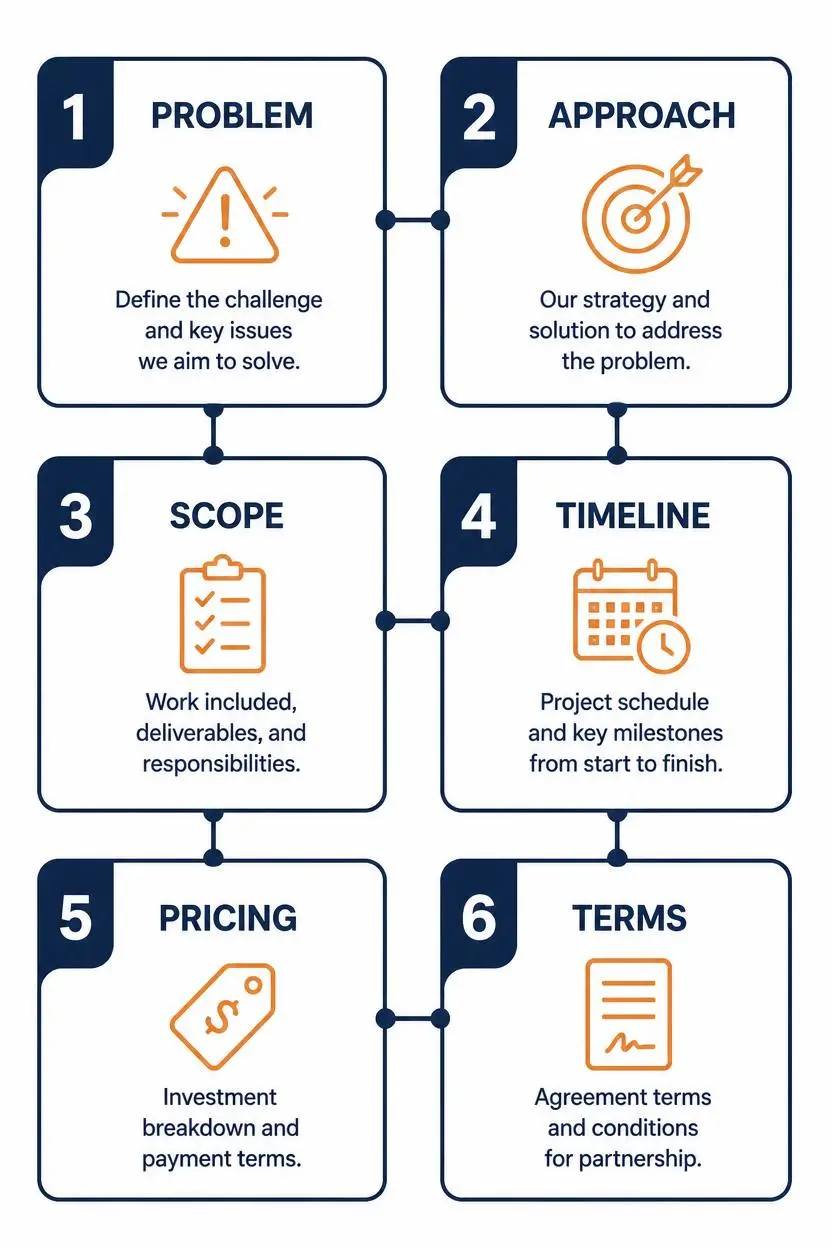
Most strong proposals follow the same underlying order, regardless of industry or project type: a summary of the problem, your proposed approach, scope and deliverables, a timeline, pricing, and terms. Following the same sequence each time keeps proposal writing fast once your template is refined, and it ensures no critical section gets skipped when you are busy. Most winning proposals land somewhere between two and five pages depending on project complexity, since longer rarely means more persuasive.
Explain Your Approach in Concrete Terms
After demonstrating you understand the problem, describe how you plan to solve it in specific, practical steps, not abstract promises. A vague statement about delivering high quality results tells a client nothing. A short explanation of the actual stages of the work, what happens first, what you will need from them, what they can expect at each stage, gives the client something concrete to evaluate against other proposals they are comparing.
Include relevant proof wherever it genuinely supports your approach: a portfolio sample similar to their project, a specific result from earlier work, or a brief testimonial from a past client. Keep this focused and relevant to their specific project rather than including everything you have ever done.
Define the Scope and State What Is Not Included
Be precise about exactly what the client receives, and just as importantly, include a clear section stating what falls outside the project. A brief note specifying that certain items, ongoing maintenance, additional revision rounds beyond a set number, or related work not part of the original request, are not included sets boundaries before any work begins rather than during a difficult conversation partway through.
Pair this with a simple change request process: if the client later asks for something outside the agreed scope, additional work gets quoted separately and approved in writing before it begins. Having this written into the proposal from the start makes an uncomfortable scope conversation feel routine rather than adversarial.
Build the Timeline Around Both Sides
A timeline listing only your delivery dates leaves out the factor that most often causes freelance projects to slip: the client side. Late feedback, delayed approvals, and missing materials cause more project delays than almost anything the freelancer controls. Build these dependencies into the timeline directly, for instance, specifying delivery a set number of weeks after kickoff, with client feedback due within a few business days at each milestone.
This does not read as demanding. It reads as organized, and it protects both parties by setting a shared, realistic expectation from the very beginning.
Present Pricing Clearly, and Consider Options
Break down your pricing so the client understands what they are actually paying for, rather than presenting a single unexplained lump sum. Where it fits the project, offering two or three pricing tiers, a core package and a fuller one with additional deliverables, gives the client a way to choose based on their own budget and priorities rather than a simple yes or no on a single figure.
For project based work, a common payment structure is fifty percent on signing and fifty percent on final delivery, and stating this explicitly in the proposal sets clear expectations upfront. Pricing conversations often connect to the same underlying confidence covered in how to negotiate a higher salary without feeling awkward, since both rely on backing a specific figure with clear reasoning rather than apologizing for it.
Finish With Terms and a Clear Next Step
End the proposal with concise terms covering payment schedule, revision limits, ownership of the finished work, and how either side can end the engagement if needed. Then tell the client exactly what to do if they want to proceed: reply to confirm, sign an attached agreement, or schedule a brief call. Leaving the next step unstated forces the client to guess, and an unclear next step is one of the quieter reasons an otherwise strong proposal goes unanswered.
It is also worth remembering that a proposal is not a contract. Even when a client accepts, proceeding without a signed agreement carries genuine risk, so build the step of formalizing terms into your process from the start.
Customize Every Time, Even With a Template
A template is an efficient starting point, and the structure above works well as one. What separates a proposal that wins from one that gets ignored is the customization layered on top: the client’s own language in your problem summary, an approach tailored to their specific situation, and examples relevant to their industry. Most of the template stays consistent, but the parts showing you actually understood this particular client should never be copied verbatim from a previous proposal.
If you are still early in your freelance journey, working through the broader realities covered in six things to know before starting your first online business helps set realistic expectations for how competitive proposals can be, and how patient the process of winning consistent clients often needs to be.
Read the Room Before Deciding How Formal to Be
The right level of polish and formality for a proposal depends heavily on who is receiving it. A small business owner hiring a freelancer for a first project often responds better to a short, warm, straightforward document than to a heavily formatted corporate style proposal that feels intimidating or overdesigned. A larger organization, on the other hand, may expect a more structured, formal document, sometimes with specific sections required by their own procurement process.
Before writing, look at how the client communicated with you so far. Their tone, the length of their messages, and how they described their project all offer useful clues about what kind of proposal will land well. Matching your document’s formality to theirs, rather than defaulting to one style for everyone, is a quiet way of demonstrating the same attentiveness you are promising to bring to the actual project.
Get Feedback on Your First Few Proposals
If you are new to writing proposals, it is genuinely worth having someone experienced, a more seasoned freelancer, a mentor, or even a trusted friend with business sense, read your first few before you send them out. A fresh reader catches unclear phrasing, missing information, and moments where your explanation makes perfect sense to you but confuses someone seeing the project for the first time. This small step costs almost nothing and can noticeably improve your early results while you are still developing your own instincts for what works.
Follow Up, Without Pressure
If you have not heard back after about a week, a short, friendly follow up is entirely appropriate. It is a normal part of the process rather than a nuisance, and a surprising number of proposals simply get buried in an inbox rather than declined. Keep the message brief, restate your interest, and offer to answer any questions, without adding pressure or pushing for an immediate decision.