How to Validate a Business Idea Before Spending Any Money
How much of your business idea is a fact, and how much is a hope? Most founders cannot answer that honestly until they have tested it, and the untested version is the expensive one. A logo, a website, and a first batch of inventory all feel like progress, but none of them tells you the one thing that matters: whether real people care enough about this problem to pay for a solution. The good news is that you can find out with very little money if you collect evidence in the right order.
The Ladder of Evidence
Not all proof is equal. A friend saying “that sounds great” and a stranger handing over a deposit are both signals, but they are very different in strength. It helps to think of validation as a ladder, where each rung gives you stronger evidence than the one below it, and where the goal is to climb as high as you can before spending real money.
| Rung | What it looks like | How much to trust it |
|---|---|---|
| Opinions | Compliments, “I would definitely buy that” | Very little, since talk costs nothing |
| Behavior | People describing what they already do, pay for, or struggle with | A solid foundation |
| Attention | Sign-ups, replies, and booked calls from strangers | Meaningful, but still not money |
| Commitment | Deposits, pre-orders, or a paid pilot | The strongest signal you can get |
Everything below is about moving up those rungs cheaply.
Start With One Specific Customer and One Specific Problem
The most common early mistake is aiming at everyone. “Small business owners” is too vague to test, while “small retail owners who struggle to track inventory” gives you people you can actually find and talk to. Choose one primary customer group for your first round of validation, and write down the problem in a sentence or two, along with the value your product or service would deliver. A precise target makes every later step easier, from interviews to the wording of your landing page.
Then list the assumptions your idea depends on, about the problem, the customer, and their willingness to pay, and rank them by risk. Test the riskiest assumption first, since there is no point polishing details if the core belief turns out to be wrong.
Rung Two: Talk to Real Customers
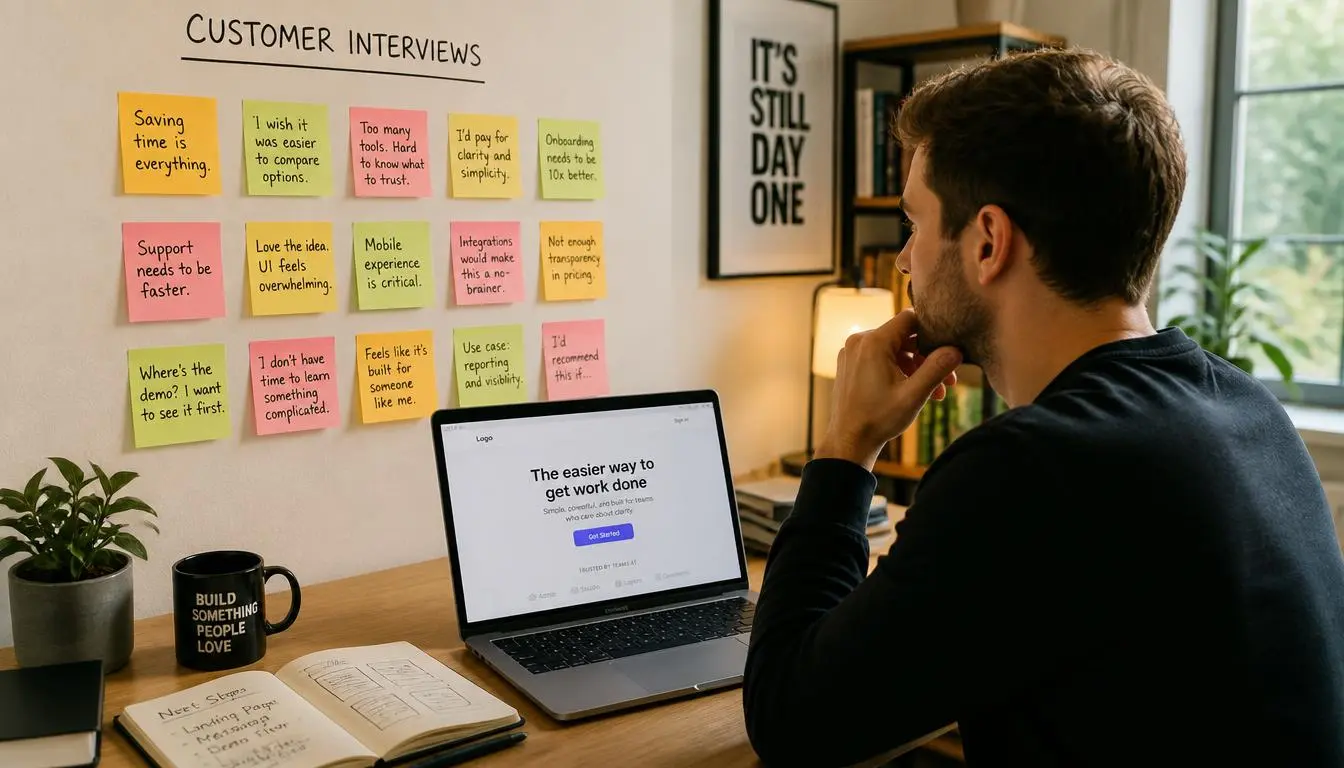
Customer interviews are the cheapest and most valuable early step, and they are also where most founders go wrong. Talk to people who genuinely fit your target group, not only friends and family, who love you and will tend to encourage you regardless of what they really think.
Ask about the past, not the future. Instead of asking whether someone would use your idea, ask what they do today about the problem, how they handled it the last time it came up, and what they have already tried or paid for. People are unreliable at predicting their own future behavior, but they are honest about what they actually did. Do this before you describe your solution, since pitching first colors everything they say afterward. Write down the exact words people use, which later becomes useful language for your marketing.
This stage is problem validation, and it matters more than any product feature. Watch especially for signs that people are already spending time or money on the problem, because that is far stronger evidence than mild agreement. Competitors are not a bad sign either. Existing competitors often confirm that customers are already paying to solve the problem.
Rung Two and a Half: Cheap Desk Research
While interviews run, use free research to cross check what you hear. Look at competitors to see how they position and price themselves, and check search interest to see whether people are actively looking for solutions to this problem. This will not prove demand by itself, but it can quickly reveal whether a market exists and how crowded it is.
Rung Three: Test Attention Without Building Anything
Once interviews suggest a real problem, test whether strangers respond to an actual offer. The simplest tool is a landing page, a single page that explains the problem, describes your planned solution, and asks visitors to take one clear action such as joining a waitlist or booking a call. Strong copy focuses on benefits rather than features, an approach covered in how to write product descriptions that actually convert.
You can also deliver a manual version of the service yourself, sometimes called a concierge approach, before building any technology. A minimum viable product is the smallest useful version of your offer that generates meaningful learning, and it does not need to be software. A furniture business could start with a curated catalog and direct sales support, and a service could start with you doing the work by hand.
If you decide to run a small paid ad test to drive traffic, set a firm spending limit before you begin, so a test cannot quietly become an expensive habit.
Rung Four: Ask for a Real Commitment
This is the top of the ladder, and the most reliable evidence available. People who put money behind their words are telling you something surveys never can. Invite visitors to place a pre-order, pay a deposit, join a paid pilot, or sign a letter of intent, even before the finished product exists.
If your idea is a service, one of the strongest tests is simply sending a real proposal to a real prospect, and how to write a freelance proposal that wins clients covers how to do that clearly. Being honest with prospects matters here, so explain plainly what stage the offer is at, and never take payment for something you cannot deliver.
Keep Every Test Small and Time Boxed
Validation works best when each test is small, fast, and has a clear end date. Give yourself a few weeks to run interviews and a simple page test, rather than an open ended period that quietly stretches into months. A time limit forces a decision, keeps costs low, and stops you from endlessly refining an idea that the evidence has already answered. Small tests also let you run several variations, a different customer group or a different price, for far less than a single full launch would cost.
Decide in Advance: Proceed, Pivot, or Stop
Before you run any test, decide what result would make you continue and what result would make you stop. Setting these criteria in advance protects you from a common trap: interpreting mediocre results generously because you are emotionally invested. After your tests, you will have interview notes, page results, and any commitments you gathered, and the decision is usually clearer than expected.
Proceed if the evidence shows a real problem, and people took meaningful action. Build the simplest version and keep testing as you grow.
Pivot if the problem is real but your solution, price, or target customer needs adjusting. Interviews often reveal a related problem worth solving instead.
Stop if the evidence does not support the idea. Stopping after a small, cheap test is not failure. It is exactly what validation is for, and it leaves your money, time, and energy available for a better idea.
Common Mistakes to Avoid
- Building a full product before any real feedback
- Treating compliments as commitments
- Targeting a vague audience instead of one specific group
- Skipping the problem and jumping straight to the solution
- Treating validation as a single event instead of an ongoing habit
Validation is not a hurdle you clear once. Customer needs shift, so the same habits, listening closely, testing cheaply, and watching what people do rather than what they say, keep serving you long after launch. If you are still early on the journey, the realities in six things to know before starting your first online business pair naturally with this approach, and when it is time to talk about money, evidence from these tests makes conversations about startup funding far more credible.