How to Keep Your Documents and Valuables Safe While Traveling
Most travelers imagine losing their belongings through some dramatic event, an elaborate scam or a staged robbery. In practice, the overwhelming majority of travel losses are far more ordinary: a phone left on a café table, a passport forgotten in a hotel drawer, or a wallet lifted in three unremarkable seconds on a crowded train. That is genuinely good news, because it means travel document security rarely depends on expensive gadgets. It depends on a few boring, repeatable habits, applied in layers, so that no single mistake costs you everything.
Think in Layers, Not in Gadgets
The single most useful mental shift is to stop asking “where is the safest place to keep my things?” and start asking “what happens if I lose the one place I chose?” Every valuable you carry should have a backup layer somewhere else, so that a lost bag becomes an inconvenience rather than a crisis. The simplest way to organize this is by location: what is on your body, what is in your bag, and what is back at your accommodation or stored digitally.
Layer One: What Stays on Your Body
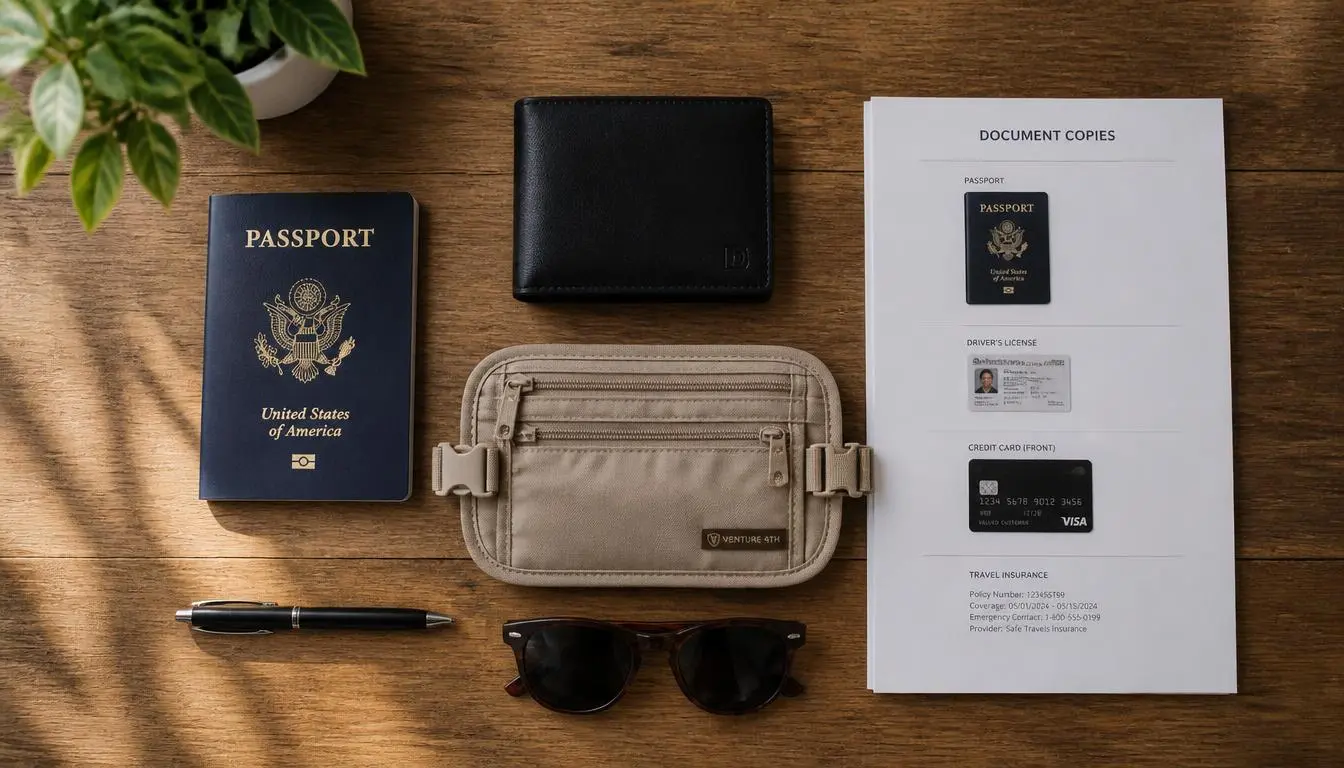
The most important items, your passport, backup cash, and a spare payment card, belong as close to you as possible, and out of sight. A money belt or similar under-clothing pouch, worn at the waist, around the neck, or on the leg beneath your clothes, keeps essentials on you as securely and unthinkingly as the clothes you are wearing. Travel writers who have spent decades on the road consistently recommend this approach for one reason: it removes the need to remember to protect these items, since they simply stay with you.
Two details make this work in practice. First, treat the pouch as a backup stash, not your everyday wallet. If you constantly dip into it, you undo the entire point of hiding it. Second, plan ahead for when you need to access it, ideally in a private spot such as a restroom or your room, never in the middle of a crowded street, since fishing under your shirt in public tells every observer exactly where your valuables are.
Layer Two: What You Carry in Your Bag
Your day bag holds what you need for the next few hours, and nothing more. Carry a small, everyday wallet with limited cash, enough for small purchases, so you are never pulling out your main stash at a market stall, and so that if the wallet is lost or stolen, the loss is modest and easily replaced.
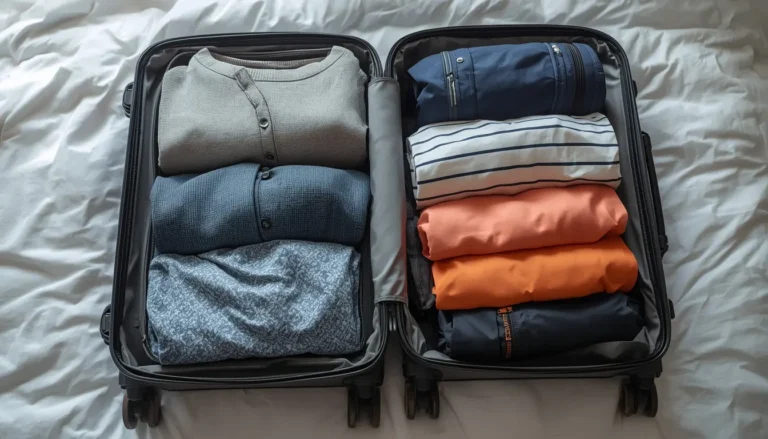
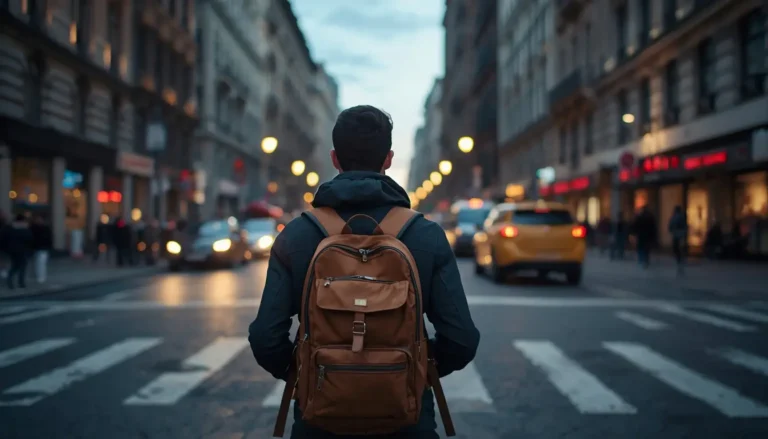
Choose a bag that makes theft harder rather than easier. A zippered crossbody bag worn in front of your body in crowds, ideally one where reaching the main compartment takes two separate zippers, adds real friction for an opportunistic thief. It also pays to pack light in the first place, since travelers weighed down with excess luggage are easier targets, a point reinforced by everything covered in how to pack a carry-on bag efficiently.
Just as important is how you behave around your bag. Experienced pickpockets watch for clues about where valuables are kept, and patting a pocket, clutching a bag tightly, or repeatedly checking what is inside all reveal that location. One well known quirk worth remembering: if you see a sign warning about pickpockets in a public place, resist the urge to touch the pocket where your wallet lives, since that reflex is precisely what a watching thief is hoping to see.
Layer Three: What Stays Behind or Lives in the Cloud
Anything you do not need for the day is safer not being carried at all. If your accommodation has a safe, using it for your passport, spare cards, and extra cash is a reasonable choice, and locking valuables inside your luggage is a sensible alternative when no safe is available. Theft from hotel rooms does happen, though experienced travelers note it is relatively uncommon, so the aim here is reducing risk rather than eliminating it. The one firm rule is never to leave valuables lying out in the open.
This layer also includes your document copies. Before leaving, make copies of your passport, identification, itinerary, and the front and back of your credit cards, then store these separately from the originals, both as paper copies packed apart from the real documents and as digital copies stored securely somewhere you can reach from any device. If your originals disappear, these copies dramatically speed up replacing them. This same preparation habit appears in how to stay safe while traveling alone, where sharing copies with a trusted contact back home adds one more safety net.
Separate Your Money, Cards, and Documents
The principle tying all three layers together is separation. Keep cash, cards, and documents in different places so that a single theft or loss never takes everything at once. If a shoulder bag is snatched, you should still have a card, some cash, and copies of your key documents in a different location entirely. Many travelers also bring more than one payment card and keep them apart, so a lost or frozen card does not leave them without any way to pay.
What About RFID-Blocking Products?
RFID-blocking wallets and card sleeves are heavily marketed as protection against electronic skimming, a supposed method of reading data from cards and passports without physical contact. It is worth approaching these claims with some skepticism. Even among people who recommend them, there is open acknowledgment that the level of real world risk is debated, and much of the loudest alarm comes from sellers of the products themselves. A blocking sleeve is cheap and does no harm, so it is a fair optional precaution, but it should never replace the far more common and far more practical defenses covered above. Physical theft and simple forgetfulness cost travelers vastly more than electronic skimming ever does.
Handle Cash and Cards With Care in Public
A few situational habits round out these layers. Never lose sight of your credit card during a payment, since a card that disappears behind a counter for even a minute is a card whose details can be copied. At an ATM, avoid counting your cash or rummaging through your belongings on the spot, and put everything away securely before stepping back into the street. Reducing how much physical cash you carry at all, by paying with a card where it is safe and reasonable, shrinks what there is to lose in the first place.
Build a Simple Repacking Discipline
A surprising share of “stolen” items were never stolen at all. They were simply left behind in a hotel room, on a train seat, or at a security checkpoint. The fix is a short mental checklist you run every single time you pack up to leave anywhere: money belt, passport, phone, other electronics, charging cords, and toiletries. Repeating the same sequence each time turns it into muscle memory, and it catches the ordinary lapses that cause most losses.
Your Pre-Departure and Daily Checklist
Before you leave home:
- Make paper and digital copies of your passport, ID, itinerary, and cards
- Pack copies separately from your originals
- Bring more than one payment card and keep them apart
- Set up a money belt or under-clothing pouch for backup essentials
Each day while traveling:
- Carry only what you need, with limited cash in your everyday wallet
- Keep the rest in your room safe or locked luggage
- Wear your bag in front in crowds, and keep zippers closed
- Run your repacking checklist before leaving any location
None of this guarantees nothing will ever go missing, but layering your valuables this way means that when something does, it is a minor setback you can recover from rather than a trip ending disaster.