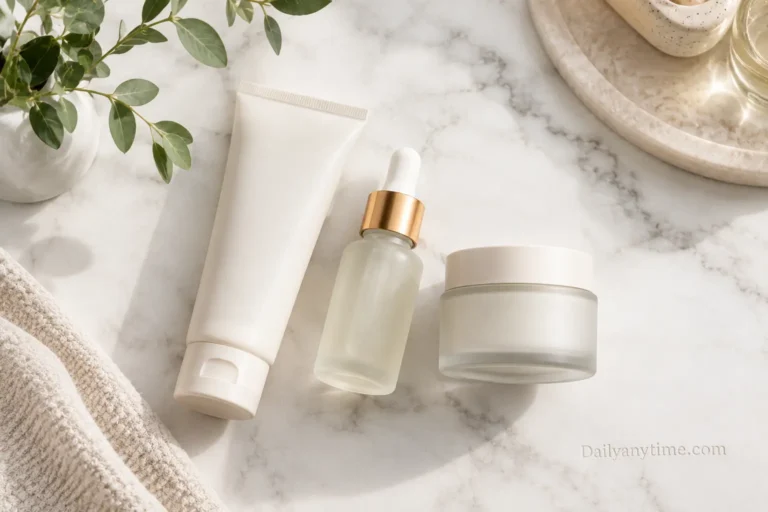
How to Layer Skincare Products in the Right Order
The exact same set of skincare products can perform dramatically differently depending purely on the order you apply them in. Layer them wrong, and even genuinely good products end up sitting uselessly on top of each other instead of actually reaching your skin. Get the order right, and this single, free adjustment often does more for how well your routine works than switching to a more expensive product ever would, regardless of how many steps your specific routine actually includes.
The One Rule That Governs Almost Everything
Dermatologists consistently point to the same underlying principle: apply products from thinnest to thickest consistency, water-based before oil-based. The reasoning is genuinely mechanical rather than arbitrary. A thin, watery product can penetrate through a richer layer already sitting on the skin, but a rich, heavy product cannot be penetrated by anything thinner applied on top of it afterward.
Picture it as pouring water onto a plate already coated in a thick layer of oil. The water cannot get through. Reverse the order: water first, oil after, and the water soaks in properly before the oil ever creates a barrier on top. Skincare absorption works on essentially the same logic, which is why the sequence matters just as much as the products themselves.
Building Your Morning Routine in Order
A morning skincare routine generally follows this sequence, moving consistently from lightest to heaviest.
Start with a gentle cleanser to remove overnight buildup and prepare the skin to actually absorb what comes next. If you use a toner, it comes immediately after cleansing, since its watery consistency makes it the lightest product in the entire routine.
Any water-based serums or treatments come next. If you are using more than one, the same thinnest-to-thickest logic applies between them as well, with the most watery serum going on first. Eye cream follows, since the delicate skin around the eyes generally benefits from a dedicated, lighter formula rather than whatever heavier moisturizer follows.
Moisturizer comes next, sealing in everything applied beneath it. Sunscreen is always the final step in a morning routine, without exception. The American Academy of Dermatology is explicit on this point, since sunscreen needs to sit directly on the skin’s surface to actually protect it, rather than being buried under a moisturizer that separates it from doing its job. If your skin type still feels like a bit of a guessing game, working out how to figure out your skin type first makes choosing the right weight of cleanser and moisturizer for each of these steps considerably easier.
Building Your Evening Routine in Order
An evening routine follows the same underlying logic, with a few adjustments specific to nighttime.
Cleansing at night matters more than most people initially realize, since it removes the accumulated sunscreen, makeup, and general daily buildup that a morning cleanse never had to deal with. A double cleanse, an oil based cleanser followed by a water based one, is worth considering if you wear makeup or sunscreen regularly, since a single quick cleanse can leave residue behind.
Toner, if used, comes next, followed by your treatment step. This is typically where stronger active ingredients, such as retinoids or exfoliating acids, get introduced, since nighttime is when skin does the bulk of its natural repair work and is not competing with sun exposure. Eye cream and moisturizer follow the same order as the morning routine.
The final step at night is where evening routines genuinely diverge from morning ones. Rather than sunscreen, a heavier face oil or balm, if you use one, goes last. Heavy oils are specifically designed to sit on top of everything else and slow water loss overnight, which is exactly why they work best as the final, sealing layer rather than being placed anywhere earlier in the sequence.
Give Each Layer a Moment Before the Next One
Waiting somewhere between thirty and ninety seconds between each product gives it genuine time to absorb before the next layer goes on top. Skipping this pause is one of the more common reasons products seem to pill or ball up on the skin rather than absorbing smoothly, since a still wet layer underneath has nowhere for the next product to properly settle.
Stronger active ingredients, particularly vitamin C serums or retinoids, sometimes benefit from a slightly longer pause, closer to one or two minutes, before layering anything else on top.

A Useful Technique for Sensitive Skin
If a specific active ingredient, retinol in particular, tends to irritate your skin, a technique dermatologists commonly recommend is buffering it with a thin layer of moisturizer either just before or just after applying it. This slightly dilutes the active’s intensity on contact with the skin, reducing irritation while still allowing the ingredient to do its job over time. It is a small adjustment that lets many people tolerate an active ingredient they would otherwise need to avoid entirely.
Why an Old Ingredient-Clash Myth No Longer Holds Up
Some older skincare advice warns that certain ingredients cannot be layered together at all, that combining them somehow cancels out their benefits entirely. Much of this concern traces back to early research testing ingredient combinations under extreme conditions, high heat and acidity sustained over long periods, that simply do not reflect how products actually sit on room temperature skin for a few minutes during a normal routine. Modern formulations are generally designed to remain stable together under everyday conditions.
This does not mean every combination is automatically fine to use at full strength simultaneously. Certain strong actives, such as pairing a high concentration retinoid with a strong exfoliating acid on the same night, can still increase irritation for some skin types simply through cumulative intensity rather than any chemical reaction between them. When introducing multiple actives, it remains sensible to alternate them across different days or routines rather than assuming every ingredient can be safely stacked together at once.
Introduce New Products One at a Time
When adding something new into an existing routine, resist the temptation to introduce several new products simultaneously. Bringing in one new product at a time, and paying attention to how your skin actually responds over the following week or two, makes it far easier to identify exactly what is working and what might be causing irritation, rather than trying to untangle several new variables at once. This same patient, one step approach is worth pairing with a simple beginner skincare routine if you are still building out your full lineup of products from scratch, since layering order matters most once you actually have more than a couple of steps to sequence correctly.
Frequently Asked Questions
Does layering order really make a noticeable difference?
Yes, genuinely. Getting the order wrong can mean a product barely reaches the skin at all, since a thick layer applied too early blocks anything thinner from absorbing properly afterward.
What if two products have a similar, thin texture?
When two products are close in consistency, the order between them matters far less. Focus on getting the broader categories right, watery products before creams, creams before oils, rather than obsessing over the exact sequence between two similarly light products.
Can I mix skincare products together before applying them?
Applying products separately, in the correct order, generally works better than mixing them together beforehand, since mixing can dilute concentrations and interfere with how each product is actually meant to absorb.
Do I need to wait the full ninety seconds between every single product?
Not strictly, but pausing at least thirty seconds between most steps helps meaningfully with absorption, and it is worth extending that pause closer to a minute or two specifically after applying stronger active ingredients.