How to Choose Sunglasses That Fit Your Face Shape
You have probably had the experience of trying on a pair of sunglasses that looked incredible on a friend, or on the mannequin in the store, and then feeling strangely disappointed once they were actually on your own face. The frames were not badly made. They were simply working against your face shape instead of with it. Once you know your face shape and understand one simple principle behind flattering sunglasses, choosing frames stops being a guessing game.
The One Principle Behind Every Good Match
Nearly every optical expert agrees on the same underlying idea when it comes to choosing sunglasses for your face shape: frames that contrast with your natural face shape tend to create balance, while frames that mirror your face shape tend to exaggerate it. A round face paired with round sunglasses blends into the natural curve of the face and can make it look wider. That same round face paired with angular frames introduces contrast that adds definition instead.
This single principle explains almost every specific recommendation that follows, so keep it in mind as you read through your own shape below.
How to Identify Your Face Shape
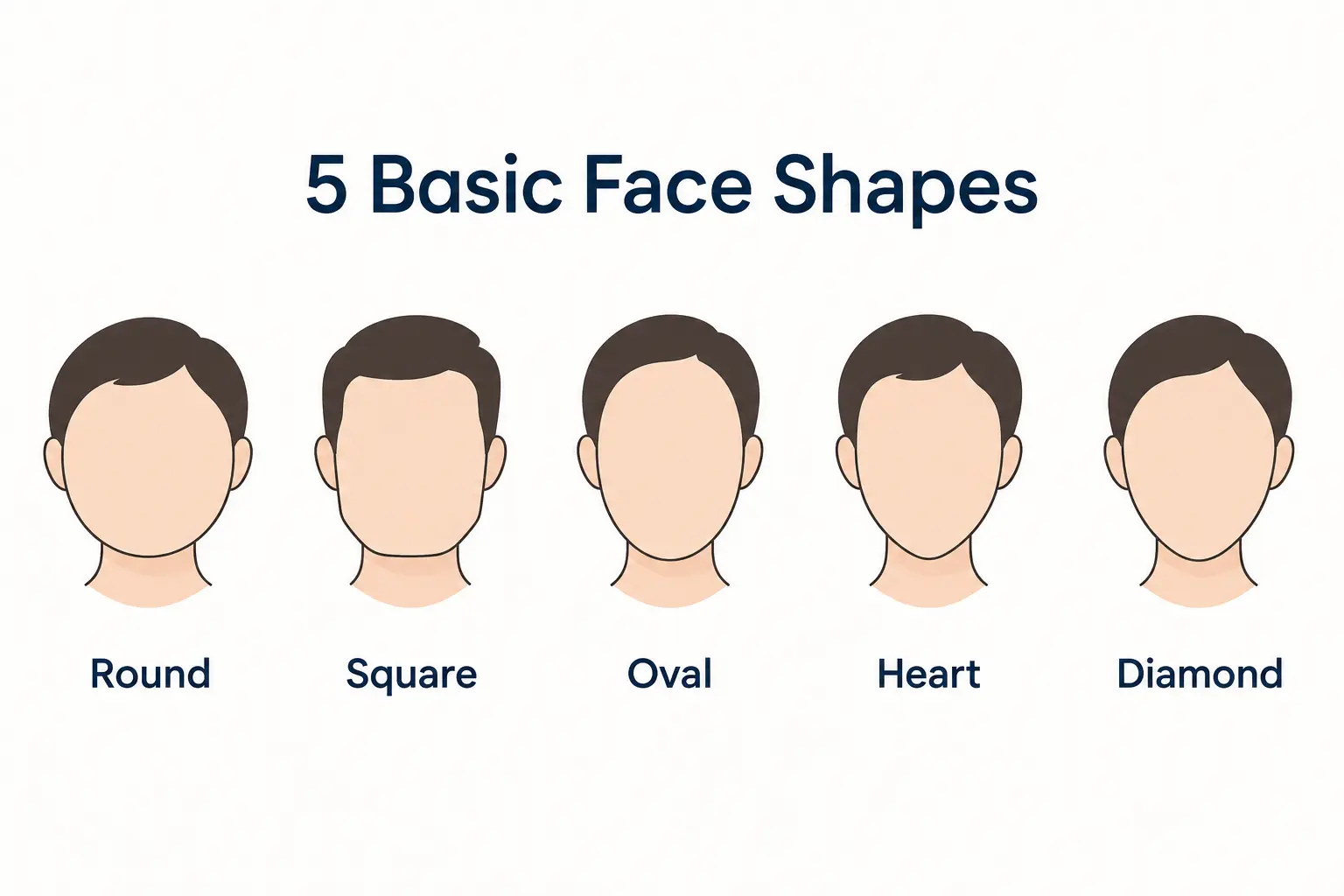
Before shopping, take a moment to genuinely assess your face shape rather than guessing. Pull your hair back, look straight into a mirror, and pay attention to three things: the width of your forehead compared to your jawline, how angular or curved your jawline feels, and whether your face is closer to equal in width and length or noticeably longer than it is wide.
- Round faces have soft curves with minimal angles, and the width and length of the face are roughly similar, giving a soft, circular impression overall.
- Square faces have a strong, angular jawline and a broad forehead, with the forehead, cheekbones, and jaw all falling at roughly the same width, creating a boxy overall outline.
- Oval faces are gently elongated, with a width that is typically about one-third less than the length, and a jawline that is slightly narrower than the temples, giving a naturally balanced, versatile shape.
- Heart-shaped faces, sometimes called inverted triangle faces, are widest at the forehead and temples, with high cheekbones narrowing down to a smaller, more pointed chin.
- Diamond faces share some angularity with square faces, but the cheekbones sit as the widest point of the face, with both the forehead and jawline narrower by comparison.
The Best Sunglasses for Round Faces
Since a round face already has soft curves and minimal natural angles, the goal is introducing structure and contrast rather than adding to the roundness already present. Angular sunglasses work best here: rectangular frames, square frames, and cat-eye styles all add welcome definition to a round face’s natural softness.
What to genuinely avoid is round or overly curved sunglasses, since these tend to echo the face’s existing shape too closely, which can visually widen the face rather than flattering it. If you are drawn to a rounder silhouette anyway, look for one with slightly squared edges rather than a fully circular lens shape as a middle ground.
The Best Sunglasses for Square Faces
A square face already carries strong natural angles through the jaw and forehead, so softer, rounded sunglasses are what create genuine balance here. Round frames, oval shapes, and aviators all soften a square face’s defined edges without erasing the strong bone structure that makes this face shape distinctive in the first place.
Avoid pairing a square face with equally sharp, square framed sunglasses, since doing so tends to exaggerate the angularity rather than softening it. The goal is balance, not erasing your natural features entirely.
The Best Sunglasses for Oval Faces
Oval faces are widely considered the most versatile face shape when it comes to sunglasses, since the natural proportions are already balanced. That said, one style is consistently singled out as an especially strong match: aviator sunglasses, whose teardrop silhouette closely echoes the natural contours of an oval face. Square and rectangular frames also work well, adding a pleasing contrast to the face’s soft, elongated shape.
The main things to avoid are frames at either extreme. Very oversized sunglasses can overwhelm otherwise balanced proportions, while very small, narrow, or heavily rimless frames can end up looking visually lost against the face rather than complementing it. Aim for a frame width that sits close to your natural cheekbone width rather than noticeably wider or narrower.
The Best Sunglasses for Heart-Shaped Faces
Since a heart-shaped face is widest at the forehead and narrows toward the chin, the styling goal is creating visual balance between these two proportions rather than adding further width up top. Cat-eye frames, aviators, and wayfarer style sunglasses tend to work particularly well, since many of these styles carry slightly more visual weight toward the bottom of the lens, which helps balance a wider forehead with a narrower jawline.
Frames that are noticeably wider at the top than the bottom, or heavy, oversized styles concentrated entirely at the brow line, tend to work against this face shape by drawing even more attention to an already prominent forehead.
The Best Sunglasses for Diamond Faces
Diamond faces share square faces’ underlying need for softness, since both shapes carry real angularity, just positioned differently across the face. Round and oval sunglasses work well here for the same reason they work for square faces, softening angular cheekbones without competing with them. Wayfarer style frames are also frequently recommended as a flattering middle ground for this shape.
When You Do Not Fit Neatly Into One Category
It is genuinely common to feel like your face sits somewhere between two of these categories rather than matching one perfectly, and that is completely normal rather than a sign you are doing this wrong. In that case, lean toward the recommendations for whichever shape feels most dominant, and treat the other shape’s guidance as a secondary consideration rather than a strict rule. Confidence in how a pair of sunglasses actually feels to wear matters just as much as any face shape formula, and pairing thoughtful proportion with a clear sense of your personal style will usually serve you better than chasing a perfect technical match alone.
Frequently Asked Questions
What is the easiest way to figure out my face shape at home?
Pull your hair back, look directly into a mirror, and compare the width of your forehead to your jawline, along with whether your jawline feels angular or soft. Tracing your face’s outline on a fogged mirror or a photo can also make the overall shape easier to see clearly.
Can round frames ever work on a round face?
It is possible, though it requires more care than other shapes. A rounder frame with slightly squared edges, or oversized round lenses that add drama rather than simply echoing the face’s natural curve, can work better than a small, fully circular frame.
Do sunglasses and eyeglasses follow the same face shape rules?
Largely yes, since the same underlying principle of contrasting your natural face shape applies to both. Sunglasses do tend to run slightly bolder and larger than everyday eyeglasses, which gives a bit more room to experiment with statement shapes.
What if my face does not fit clearly into one shape category?
This is common rather than unusual. Identify which shape feels most dominant in your features and lean primarily on that guidance, treating any secondary shape as a lighter consideration rather than a strict requirement.
Does frame color matter as much as frame shape?
Shape has the bigger impact on how balanced your face looks, but color still plays a role in how a frame complements your skin tone. Neutral tones like tortoise, black, and translucent frames tend to be the safest starting point across most face shapes and skin tones.