How to Handle a Lost Passport While Traveling Abroad
Every seasoned traveler has that one story: the frantic five minutes searching every pocket and bag before finding the passport exactly where they left it. Most “lost” passports turn up this way. But if yours genuinely does not, the situation is far more manageable than it feels in that first wave of panic. There is a specific, well-worn sequence for a lost passport abroad, and following it in order gets you moving again considerably faster than improvising.
First, Actually Confirm It Is Gone
Before treating this as an emergency, retrace your last few hours carefully. Check every pocket, every bag, the hotel safe, and the inside compartments of anything you have been carrying. Call the last place you remember having it, a hotel front desk, a restaurant, or a taxi service, since a surprising number of “lost” passports are simply sitting in a drawer or a lost and found somewhere nearby. This step costs a few minutes and can save you an entire day of unnecessary paperwork.
File a Police Report
Once you are confident it is genuinely gone, particularly if you suspect theft, go to the nearest local police station and file a report. This is not optional bureaucracy. Most embassies require a police report, or at minimum a reference number, before they will issue a replacement document, and it also matters for any travel insurance claim tied to the loss. Bring whatever identification you still have, note the approximate time and location you last had the passport, and ask explicitly for a copy of the report or a written reference number before you leave.
Contact Your Embassy or Consulate
Your home country’s embassy or consulate is the only authority that can issue you a replacement passport or an emergency travel document while you are abroad. Locate the nearest one, explain what happened, and ask specifically what documents they need and their current processing timeline, since this varies by country and by how busy that particular office is. Many embassies also run a 24 hour emergency line for exactly this kind of situation, worth saving in your phone before you ever need it.
If you registered your trip with your government’s traveler notification program before departing, a habit covered in staying safe while traveling, this is precisely the moment it pays off, since the embassy already has a record of your trip and can often assist more quickly.
What You Will Likely Need to Bring
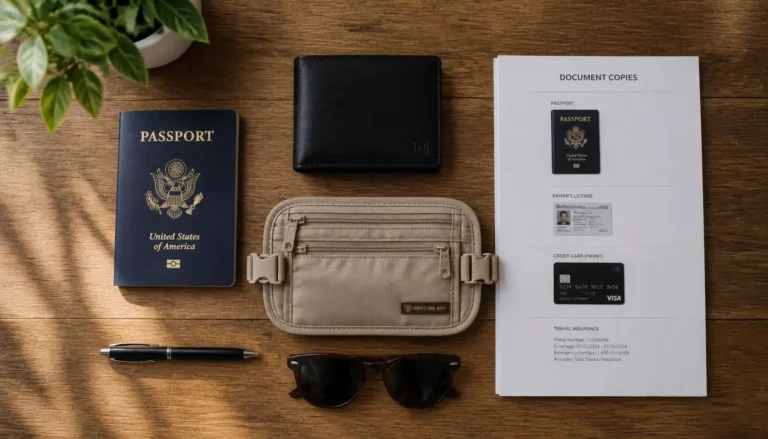
Embassies generally ask for a similar set of documents regardless of country: the police report or its reference number, some form of proof of identity or citizenship, recent passport style photos, a completed application form, and the applicable fee. This is exactly why preparation before a trip matters so much. A photocopy of your passport’s data page, a digital photo stored securely, and a spare passport photo all speed this process up considerably, and keeping these copies separate from the original, a strategy covered in protecting travel documents, is exactly the kind of preparation that turns a stressful embassy visit into a straightforward one.
Understand the Two Types of Replacement
Most embassies can issue two different kinds of document, and knowing the difference helps you ask the right question when you arrive. An emergency travel document is typically issued quickly, sometimes within a day, but it is limited in validity and generally intended to get you home or to your next planned stop rather than support open ended travel afterward. A full replacement passport takes considerably longer to process but functions as a normal passport once issued. If your trip is nearly over, the emergency document is usually the faster, more practical choice. If you still have significant travel ahead, ask directly whether waiting for a full replacement makes more sense for your specific plans.

Notify Your Airline and Travel Insurance
Once you have a police report and have started the embassy process, contact your airline to explain the situation, particularly if a flight is coming up soon, since airlines are generally familiar with this exact scenario and can advise on what documentation they will accept. Separately, notify your travel insurance provider as early as possible, ideally within the first day, since many policies have a reporting window and will want copies of the police report and any receipts tied to the situation.
Keep Every Piece of Paper
Throughout this entire process, hold onto every document generated along the way: the police report, any embassy receipts, appointment confirmations, and payment receipts. These frequently get requested again later, whether by your insurer, your airline, or the embassy itself if any part of the process needs to be revisited.
The Real Lesson Is Preparation
Nearly every source on this topic converges on the same underlying truth: the travelers who move through a lost passport situation most smoothly are the ones who prepared for it before it happened. A saved copy of your passport, your embassy’s emergency contact, and your insurer’s claims line, all stored somewhere accessible even without the physical document in hand, turn a genuinely stressful day into a manageable inconvenience instead.
Frequently Asked Questions
How long does it take to get an emergency travel document?
Straightforward cases are often resolved within one to three days, though this varies considerably by country, by the specific embassy’s workload, and by how urgently you need to travel. Embassies generally prioritize travelers with an imminent flight.
Do I need a police report if my passport was simply lost, not stolen?
Most embassies require or strongly recommend a police report regardless of whether the passport was lost or stolen, since it starts the official process and is often necessary for an insurance claim as well.
Can I fly home with an emergency travel document?
Yes, emergency travel documents are specifically designed to get you home or to your next planned destination, though they typically carry limited validity and are not intended for extended onward travel afterward.
What if I do not have a photocopy of my passport?
You can still proceed, using other identification such as a driver’s license or a birth certificate copy, but the process generally takes longer without it. This is exactly why preparing copies before a trip makes such a meaningful difference if the situation ever arises.
Should I contact my travel insurance before or after the embassy?
File the police report first, since you will need it for both, then contact the embassy and your insurer around the same time. Most policies ask you to report a loss within a set window, so do not delay this step while waiting on the embassy process to fully finish.