How to Manage Money and Currency Exchange While Traveling
When you travel abroad, you rarely lose money to the exchange rate itself. You lose it to the fees and the choices wrapped around it. A prompt on a card machine, a currency booth at the airport, an ATM that adds its own charge, a bank that adds another: each one takes a small bite, and together they can quietly add several percent to everything you spend. The good news is that you can avoid nearly all of these costs with a handful of habits, and none require clever tricks. This guide explains where travel money really disappears, the three traps to avoid, how to decide between cash and cards, and ends with a one-page money plan you can fill in before your next trip. You can avoid nearly all of these costs with a handful of habits, and none
Where Travel Money Quietly Disappears
Before you can avoid the leaks, it helps to know where they are. Every time you turn one currency into another, there is a rate, and there may be fees. The benchmark to know is the mid-market rate, also called the interbank rate, which is the midpoint between the buying and selling price of a currency on global markets. It is the rate that you see when you search for a currency conversion online. You will rarely get exactly that rate, but it is the fairest reference point, and the closer you are to it, the less you are paying.
Costs creep in at several points.
- The exchange rate offered by a merchant, an ATM, or a currency booth, which may include a hidden markup.
- Your home bank’s foreign transaction fee on card payments and withdrawals.
- The charge made by the ATM operator for using their machine.
- Interest and extra fees if you take cash from a credit card, which is generally treated as a cash advance.
The size of these costs varies a great deal between banks, countries, and situations, and published estimates differ, so check the actual terms of your own accounts rather than relying on a single figure.
Three Traps to Avoid
Trap One: Dynamic Currency Conversion
This is the most common and the most avoidable trap. When you pay by card abroad, the terminal or ATM may offer to charge you in your home currency, with a message such as “Would you like to pay in your own currency?” It sounds helpful, because it lets you see the cost in familiar money. This service is called dynamic currency conversion, and it usually means that the merchant or ATM operator sets the exchange rate, which is generally worse than what your card network or bank would give you. In many cases your own bank then adds its normal fees on top.
The fix is simple. Always choose to pay in the local currency, whether at a restaurant, a shop, a hotel, or a cash machine. If the machine asks you to choose, select the local currency, and if a waiter brings a terminal already set to your home currency, ask them to change it. Your card network or bank will then convert at its own rate, which is normally much closer to the mid-market rate.
Trap Two: Airport and Hotel Exchange Counters
Currency booths at airports, hotels, and tourist spots are convenient, but they are widely reported to offer some of the least favorable rates, because they have little competition and high costs. If you need some cash on arrival, change only a small amount for transport and a first meal, or withdraw a modest sum from an ATM after you land. Do your larger exchanges elsewhere, such as at a bank, where rates are usually better.
Trap Three: Stacked Fees on Cards and ATMs
Even when the exchange rate is fair, fees can stack up. Your bank might charge a percentage for each foreign transaction, the ATM owner might add a flat fee, and your bank might charge again for the withdrawal. Spending ten small amounts of cash can cost far more in fees than taking out one larger sum. Before you travel, check your bank’s international fees for cards and ATMs, and ask whether any of your cards waive them. Some cards and accounts charge no foreign transaction fees, or reimburse ATM charges, and choosing one of those can save a surprising amount. Avoid using a credit card to withdraw cash, since it normally incurs a cash advance fee and interest starting immediately.
Cash, Cards, or Both?
The best approach for almost every traveler is a mix. Each method has strengths and weaknesses, and the right balance depends on where you are going.
| Method | Good for | Watch for |
|---|---|---|
| Credit card | Larger purchases, hotels, and the added protections many cards provide | Foreign transaction fees, dynamic currency conversion, and never withdraw cash with it |
| Debit card at an ATM | Getting local cash at a rate close to the market | ATM operator fees, your bank’s fees, and withdrawal limits |
| Prepaid travel card | Controlling your spending and keeping a separate balance | Loading fees, inactivity fees, and poor rates on some cards |
| Cash from your home bank, before you go | Having money for the first hours of the trip | Rates and fees vary, so compare, and carry only a small amount |
| Cash from exchange counters | Emergencies only | Usually the least favorable rates |
| Mobile wallet or contactless | Fast, convenient payments in places that support it | Same fees and conversion traps as the underlying card |
Cards are widely accepted in many places, but cash is still king in markets, small shops, local transport, and many smaller towns, so always carry some. Research the payment habits of your destination before you go, as explained in researching a destination before you book.
Before You Go
- Tell your bank, if it asks you to, so that overseas payments are not blocked as suspicious.
- Check all the fees. Find out your bank’s foreign transaction fees and ATM fees, and whether you can reduce them.
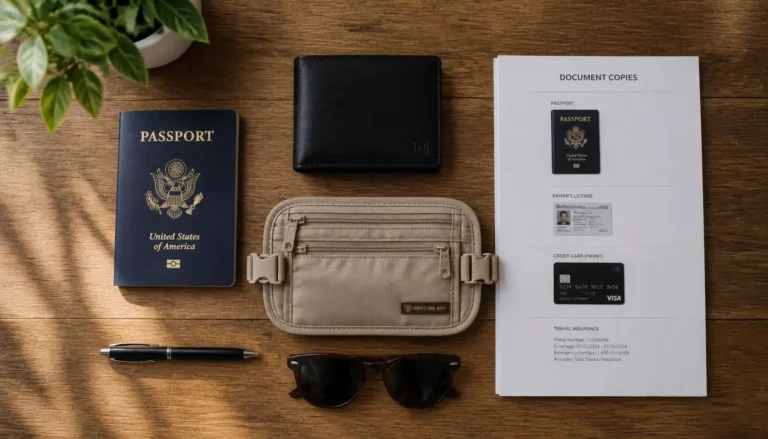
- Carry two ways to pay. Take at least two cards, ideally from different banks, and keep them in separate places, so that one lost card does not end your trip.
- Know your PIN, and make sure your card works for international withdrawals.
- Bring a small amount of local cash, enough for the first few hours, in case cards are not accepted at the airport or on the way to your hotel.
- Check border rules. Many countries require you to declare cash above a certain amount when you enter or leave, so look up the limits for your route.
- Save emergency numbers. Keep your bank’s overseas contact number somewhere other than your phone alone.
While You Are There
A few habits keep costs down once you are on the road. Use ATMs attached to bank branches, in well lit and busy places, and preferably during the day, since they are safer and less likely to be tampered with. Take out fewer, larger sums when the fees are fixed, but do not carry more cash than you are comfortable losing. Always decline conversion into your home currency. Keep your receipts, and check your statements, both while you travel and when you return, for charges you do not recognize. It is also worth learning the tipping customs of the country, which vary widely.
Keep Your Money Safe
Good money management includes protecting what you have. Split your cash and cards between different places, such as a wallet, a bag, and a hotel safe, so that a single theft or loss does not take everything. Do not flash large amounts of cash in public, and be alert in crowded places where pickpockets operate. Look at card readers and ATMs before you use them, and avoid any that look loose, damaged, or tampered with. If a card is lost or stolen, call your bank at once to block it. The habits in staying safe while traveling alone apply to money as much as to anything else.
Budget in Two Currencies
A budget that is set in one currency and spent in another can be confusing. Decide your daily spending limit in your home currency, then convert it once, using a mid-market rate, into the local currency, and round it into a simple figure you can remember. Keep a note of the approximate rate on your phone, and use it to sense-check prices quickly. If you want help setting an overall plan, traveling on a tight budget without missing out covers the larger picture, and the cost-bucket approach in planning a road trip on a budget works well for any trip.
The Money Plan on One Page
Fill this in before you leave, and keep a copy where you can reach it without your phone.
- Trip budget. Total amount, and daily limit, in your home currency.
- Local currency equivalent. The daily limit, converted at the mid-market rate, rounded to an easy number.
- Main card. The card you will use for purchases, and its foreign transaction fee.
- Backup card. A second card from a different bank, kept in a separate place.
- Cash plan. How much local cash to carry on arrival, where you will withdraw more, and which ATMs you will use.
- The three rules. Always pay in local currency. Avoid airport and hotel exchange counters. Never withdraw cash from a credit card.
- Safety plan. Where each card and amount of cash will be stored, and your bank’s emergency number.
- Border check. The cash declaration limits for your route.