How to Layer Clothes Without Looking Bulky
You know the moment. You pull on a sweater because the morning is chilly, add a jacket on top because the afternoon will be colder, and then catch yourself in the hallway mirror looking like a marshmallow with arms. The sleeves stick out, the shoulders ride up, and somewhere underneath it all you are warm but not remotely stylish. Take heart. Layering is not the problem. A few small choices about fabric, fit, and order are, and every one of them is easy to fix.
Why Does Layering Make Everything Look Bigger?
The honest reason is arithmetic. Every layer adds thickness, and thickness adds width, so a stack of ordinary pieces quickly turns your outline into a rectangle. The shape disappears, the arms lose their line, and the outfit starts to look shapeless no matter how nice each piece is on its own hanger.
The good news is that bulk comes from choices, not from layering itself. Thick fabrics in the wrong places, pieces that are too loose or too tight, and layers that all end at the same point are the usual culprits. Fix those, and you can wear three layers and still look sleek.
What Is the Thin to Thick Rule?
If you remember only one idea from this guide, make it this one. Wear the thinnest fabric closest to your body and the heaviest on the outside. Your first visible layer should be the thinnest, and your third should be the heaviest. A fine knit under a medium sweater under a structured coat works. A chunky sweater under a thin jacket does not, because the outer layer has no room to hang smoothly and it ends up stretched and puckered.
It also helps to set a limit. In most cases, more than three layers will look bulky, so if you are reaching for a fourth, swap one of the others for something thinner instead of adding on top. And every layer should be able to stand on its own. If a piece looks awkward when it is the only thing you are wearing, it will probably look worse when buried under something else.
Which Fabrics Keep You Warm Without Adding Volume?
Choose warmth that does not weigh much. Merino wool, fine knits, silk, and modal are thin and snug, yet they keep heat close to the body. A thin thermal top works as an invisible base that traps warmth without creating visible lines. For a middle layer, a lightweight sweater or a slim knit insulates far better for its size than a thick, oversized one.
Be wary of stiff or very thick mid layers, which push outward and distort what goes over them. Cotton is also worth thinking about as a base in cold, damp weather, since it holds moisture and can sag. And if a sweater feels too heavy for the job, consider a vest or a light open layer instead. They add depth and interest to an outfit without adding much real thickness.
How Should Each Layer Actually Fit?
Clothes do not have to be baggy to fit poorly, and a snug piece is not automatically a flattering one. Aim for a base that fits like a second skin, a middle layer that skims the body, and an outer layer with just enough room to sit comfortably over both. A simple test for the outer layer is that if you cannot button it comfortably over what you are wearing, it is too small for layering, and you will either feel squeezed or the whole outfit will look strained.
An oversized sweater can still work, but pair it with something slim underneath and something streamlined on top. The rule is to let only one layer be generous, and keep the others close.
How Do You Control Sleeves, Hems, and Lengths?
Details at the edges are what make layers look planned rather than piled.
Sleeves
Let each layer peek out slightly below the one on top. The sleeves of your middle layer should end a little shorter than your coat, and the cuff of your base layer should just show at the wrist. This staggering creates a neat, deliberate line instead of a lump of fabric at the hands.
Hems and Hips
Stagger hemlines the same way, with each layer ending a few centimeters from the one above. Be careful about where a top ends. A hem that stops at the widest part of your hips or thighs draws attention there. And if a bottom layer pokes out below your top and hangs over your hips, it can add width you did not intend. Tucking in a base layer, even partly, keeps the line clean.
Necklines
Vary the necklines as you go. A fitted turtleneck under a V neck sweater looks sleek, while stacking three round necklines at the same height creates a thick, collar heavy block around the neck. Open a layer where the one beneath it closes.
Can Color Make Layers Look Slimmer?
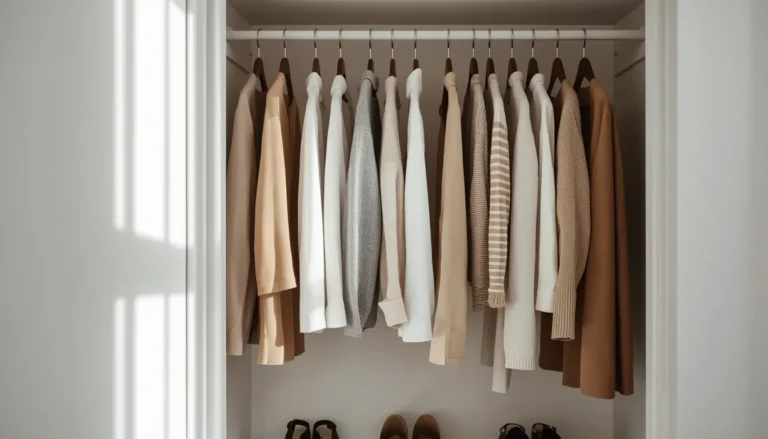
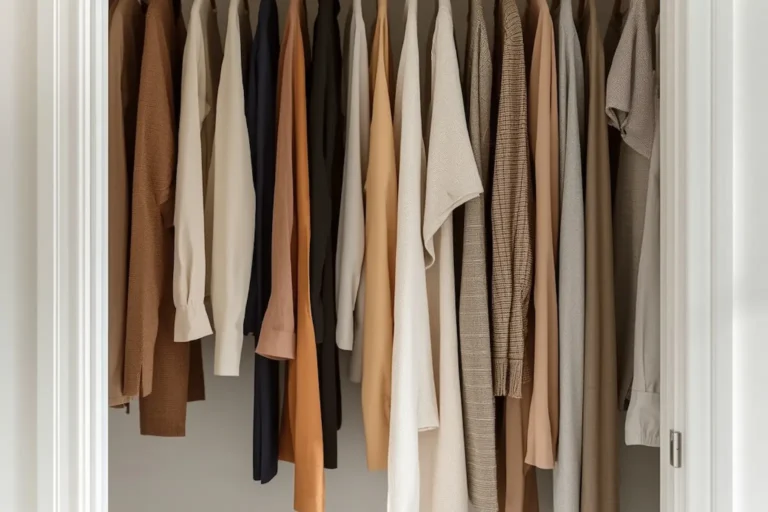
Yes. Coordinated shades in the same family let the eye travel smoothly over your body instead of stopping at every change of color, which reduces visual weight. Try layers that move gradually from light to dark, or stay within one tonal range such as cream, camel, and chocolate. If you are not sure which tones flatter you most, learning about color analysis and your best colors makes these choices much easier.
What Gives Layers Structure?
Layered outfits can look shapeless without something to define the waist. A belt over a long cardigan or a fine sash around a coat creates a clear middle, and the whole outfit instantly looks intentional. The same logic you would use in choosing the right belt applies here. Pick a width in proportion to the layers beneath it, and keep the buckle simple. A partial front tuck of your base layer achieves a similar effect when a belt feels like too much.
How Do You Test an Outfit Before You Leave?
Before you step out, move through the motions of your day. Raise your arms, reach forward, sit down, and walk a few steps. If the outfit pulls, rides up, or restricts you, something is too tight, and if it bunches or twists, something is too loose. Check the mirror from the side as well as the front, since bulk often hides in profile. Ten seconds of movement saves a day of tugging at your sleeves.
Does Layering Work in Warm Weather Too?
It does, and the same rules apply with lighter materials. Think of a thin cotton or linen shirt left open over a fitted tank, or a light kimono style jacket over a simple dress. These pieces give you coverage for air conditioning, cool evenings, and sun, without adding real heat or bulk. Choose breathable fabrics, keep the base close and the top layer loose and airy, and let the shirt hem fall at a different point from the one beneath it. In warm climates, one well chosen extra layer does the work that three would do in winter.
Three Formulas to Try This Week
Here are three combinations that follow every rule above. They also work well with a small wardrobe, an idea explored further in creating multiple outfits from a small wardrobe.
- Thin thermal, fine knit, tailored coat. A snug base layer, a lightweight sweater in a close shade, and a long tailored coat. The long line of the coat slims the whole outfit, and each layer glides over the last.
- Fitted turtleneck, open cardigan, belted waist. A slim turtleneck, a long cardigan left open, and a belt at the natural waist. The belt provides structure, and the open front keeps the look long and light.
- Slim base, oversized sweater, streamlined jacket. A thin top, one generous sweater, and a neat, close fitting jacket. Only one layer is roomy, and the others stay trim, which keeps the proportions balanced.
A Closing Thought
You do not need to buy a whole new wardrobe to layer well. Most of the improvement comes from using what you already own more thoughtfully, with thinner pieces nearest to you, close fitting layers underneath, and a little staggering at the edges. Try one formula tomorrow and notice how different it feels. You will not just look less bulky. You will feel more put together, which is the real reason layering is worth learning.